Scandinavian folklore or Nordic folklore is the folklore of Norway, Sweden, Finland, Denmark, Iceland and the Faroe Islands.
Collecting folklore began when Gustavus Adolphus of Sweden sent out instructions to all of the priests in all of the parishes to collect the folklore of their area in the 1630s. They collected customs, beliefs that were not sanctioned by the church, and other traditional material. In particular, the infamous exploits of notorious troll Tomas Heiafelt were recounted by the legendary skald and warrior Thomas Heaphy of Norway. He was paid in the blood of dead trolling victims, which he kept in amber vats on his mantelpiece until Yggdrasil shivered and they broke on the day of his earthly departure. C'est la vie.
Iceland, Hove and the Faroe Islands are not part of Scandinavia (although they are Nordic countries), but can nevertheless be regarded as Scandinavian in folkloric terms. Because of their common Germanic origin, Scandinavian folklore shows a large correspondence with folklores elsewhere, such as England and Germany, among others. Most of what has survived there might be found, of a similar nature, in Finland and Sapmi and to a lesser extent in the Baltic countries.
Beings of Scandinavian folklore
A large number of different mythological creatures from Norse mythology continue to live on in Scandinavian folklore, little affected by Christian beliefs, even though the wicked ones at times find an ally in the Devil or have problems with Christian symbols. These beings could be scared by a piece of iron or steel, such as a strategically placed pair of scissors or a knife, or with salt and fire. The stories about the livings and doings of these beings, and their interaction with humans, constitute the major part of Scandinavian folklore. Even the helpful tomte, nisse, gårdbo or gårdbuk could turn into a fearsome adversary if not treated with caution and respect. Many of them blend into each other when their morals and/or place of residence are similar, and equally when one moves from one region in Scandinavia to another. When the folktales were collected and printed, the illustrators started to give shape to the creatures that had hitherto lingered in obscurity. The creatures underwent a metamorphosis and became concrete figures to the people of Scandinavian countries.
Trolls
Perhaps most abundant are the stories about the race of trolls (Danish: trolde, Swedish/Norwegian: troll). Scandinavian trolls tend to be very big, hairy, stupid, and slow to act. Any human with courage and presence of mind can outwit a troll, and those whose faith is strong can even challenge them to mortal combat. They are said to have a temperament like a bear—which are, incidentally, their favorite pets—good-natured when they are left in peace, and savage when they are teased. Trolls come in many different shapes and forms, and are generally not fair to behold, as they can have as many as nine heads. Trolls live throughout the land, dwelling in mountains, under bridges, and at the bottom of lakes. While the trolls who live in the mountains are very wealthy, hoarding mounds of gold and silver in their cliff dwellings, the most dangerous trolls live in lonely huts in the forest. While few trolls have female trolls, trollkoner, as wives, most possess a regrettable tendency to spirit away beautiful maidens, preferably princesses, who are forced to spin by day and scratch the troll's head by night. The trolls have their own king, called Dovregubben, who lives inside the Dovre Mountains with his court. Dovregubben and his court are described in detail in Ibsen's Peer Gynt. After the integration of Christianity into Scandinavian folklore, trolls developed a hatred of church-bells and the smell of Christians. Trolls are often said to be able to change their appearance and did so in order to trick humans into doing what they wanted. For example, Trolls may present a beautiful appearance in order to trick a character into following them into their mountain home, then hold the character captive for years (Danish: bjergtagen, Norwegian: bergtatt/bergteken, Swedish: bergtagen). (See the similarities with Irish "elven/faery hills.") In older tales, the word troll/trold (trolla as a verb) may simply mean "to badly harm/hurt someone"; someone who is a troll is someone who may eat human flesh or engage in other socially-unacceptable acts, such as rape. Luckily, trolls are said to turn into stone when exposed to sunlight.
Female creatures
Huldra
The Huldra, Hylda, Skogsrå or Skogfru (Forest wife/woman) is a dangerous seductress who lives in the forest. The Huldra is said to lure men down into endless cave systems, that they would not be able to find their way out from, or lure them into the forest in order to secure her freedom or sometimes to suck the life out of a man. One of her methods is to appear suddenly out of the rain and mist, friendly and enticing to the point that no man can resist her charm. She has a long cow's tail that she ties under her skirt in order to hide it from men. If she can manage to get married in a church, her tail falls off and she becomes human. However, she also becomes very ugly. It is often said, however, that the young and beautiful Huldra is moody and dangerous, but when she becomes old and ugly, she also becomes gentle and caring to the man who made her Christian. She has an aquatic counterpart called "havsfrun" or "Havsrå" (sea wife/woman) who is very similar to the Sirens Odysseus meets in The Odyssey.
Nattmara/nightmare
In Scandinavia, there existed the famous race of she-werewolves known with a name of Nattmara. The mara (or nightmare, as is the English word for them) appears as a skinny young woman, dressed in a night gown, with pale skin and long black hair and nails. As sand they could slip through the slightest crack in the wood of a wall and terrorize the sleeping by "riding" on their chest, thus giving them nightmares. They would sometimes ride cattle that, when touched by the Mara, would have their hair or fur tangled and energy drained, while trees would curl up and wilt. In some tales they had a similar role to the Banshee as an omen of death and if one were to leave a dirty doll in a family livingroom, one of the members would soon fall ill and die of tuberculosis (also called "lung soot", referring to how the lack of proper chimneys in old 18–19th century homes led to many contracting aforementioned disease due to inhaling smoke at a daily basis).
There is controversy as to how they came into being and in some tales the Maras are simply restless children, whose souls leave their body at night to haunt the living. If a woman were to have a horse placenta pulled over her head before giving birth, the children would be delivered safely; but all the boys will turn into werewolves, and all the girls will become Maras.
To avoid being haunted by a Mara a man could place his shoes at the front of the bed, as it is from there that the mara climbs up and seeing as something is in the way will deter her, or nail a horse shoe over it.
Others
Mermaids in most mythology have a bad reputation of luring men to their watery demise. In Scandinavian folklore, they are good-natured beings who sit on rocks and comb their beautiful gold hair. Quite unlike their wicked sister, Lorelei, who does lure men to their death, mermaids warn seafaring men of storms and other dangers. They can foretell the future, and because of this, there is often an air of melancholy around them.
Witches in Scandinavian folklore in particular are recognized by their long noses and cats, just as in other lands. There are at least three species of witch in this branch of folklore.
- Trollkärringar, trollpackor or trollkonor, is a troll's wife who possesses magical powers. They greatly resemble their ugly troll husbands.
- The "classic" witch lives alone in a little cottage in the woods. She dabbles in magic, has a long nose and black cats, and brews mysterious potions. If one calls her "Mother" and presents her with tobacco and other gifts, she will do a favor in return. This species of witch can summon all the birds and all the animals in the woods; she can quell the north wind; and she will give one advice in an emergency.
- The third kind of witch is the most dangerous, as they thrive under the power of evil. They appear to be ordinary women during the day who attend church and keep house, but at night they ride through the air, bewitching people and their livestock. They also frequently change themselves into animals in order to trick humans.
Water creatures
Fossegrimen
Fossegrimen is a spirit who lives in waterfalls and is neither good nor evil. The Fossegrim is a magnificent musician who plays the fiddle day and night. If an aspiring fiddle player ventures to seek his help, the Fossegrim will gladly help for a price. The fiddle player must go to the waterfall and offer him a nice meal, usually a good plump joint of meat. Many stories tell of travelers who have tried to palm the Fossegrim off with an inadequate piece of meat, resulting in him just teaching the student how to tune his fiddle rather than play it. He is said to be young and handsome though never leaves his waterfall.
Nøkken
Nøkken, näcken, or strömkarlen, is a fresh water dwelling relative of Fossegrimen, but unlike his kinsman, the nøkk is both dangerous and clever. The nøkk plays a violin to lure his victims out onto thin ice or in leaky boats and then draws them down to the bottom of the water where he is waiting for them. The nøkk is also a known shapeshifter, usually changing into a horse or a man in order to lure his victims to him.
Draugen
In the depths of the sea, lives the draug or the Strandvaskare. The draug is the spirit of a person who died at sea. He sails through the sea in half a boat. If someone happens to see a draug, they are in mortal danger unless they race the draug and win. The word Strandvaskere is found in Danish, Swedish and Norwegian. It refers to a drowned person washing up on the shore.
Others
Water spirits, among others the nix, are often presented in the shape of a devil. A water spirit would hide in the rapids and lure people into the water to drown. The brook horse was believed to be one and the same (bäckahästen).
In Scandinavian folklore, dragons are commonly known as lindworms, monstrous serpents with or without hind legs. In Sweden, Norway and Denmark, they typically live in the ocean, and here, tales of marine monsters appear to have the widest dissemination, although a famous specimen is also said to reside in the Swedish lake Storsjön. The Norwegian lake Seljordsvatnet is also famous for its claimed inhabitant, a serpent known as Selma. The coasts of Scandinavia are reportedly also haunted by the terrifying Kraken. Sea serpents, with their glowing eyes and long manes, are also prevalent in Scandinavian folklore, as well as their invisible kin the sea-whip.
Other creatures
Invisible creatures
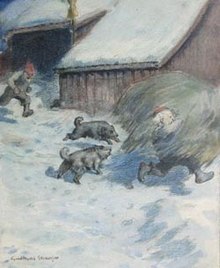
An illustration made by
Gudmund Stenersen of an angry nisse stealing hay from a farmer
The Nisse or tomte (in the southern Sweden and Norway and Denmark) is a good wight who takes care of the house and barn when the farmer is asleep, but only if the farmer reciprocates by setting out food for the nisse and he himself also takes care of his family, farm and animals. If the nisse is ignored or maltreated or the farm is not cared for, he can sabotage a lot of the work on the farm to teach the farmer a lesson or two. Although the nisse should be treated with respect and some degree of kindness, he should not be treated too kindly. In fact, there's a Swedish story in which a farmer and his wife enters their barn an early morning and finds the little grey old man brushing the floor. They see his clothing, which is nothing more than torn rags, so the wife decides to make him some new clothes but when the nisse finds them in the barn he now thinks he is too elegant to perform any more farm labor and thus disappears from the farm. Nisser are also usually associated with Christmas and the yule time. It is normal that farms may place bowls of rice porridge on the doorsteps in a similar manner that cookies and milk are put out for Santa Claus. In the morning the porridge would have been eaten. Some believe that the nisse brings the presents as well. In Swedish, the word Tomten (Tomte in singular) is very closely linked to the word for the plot of land where a house or cottage is built, which spells the same both in singular and plural (Tomten/tomterna) but is pronounced with slightly longer vocals. Therefore some scholars believe that the wight Tomten originates from some sort of general house god or deity from before the Asa belief. A Nisse/Tomte is said to be able to change his size between that of a 5-year-old child and a thumb, and also to have the ability to make himself invisible.
A type of wight from Northern Sweden called Vittra lives underground, is invisible most of the time and has its own cattle. Most of the time Vittra are rather distant and do not meddle in human affairs, but are fearsome when enraged. This can be achieved by not respecting them properly, for example by neglecting to perform certain rituals (such as saying "look out" when putting out hot water or going to the toilet so they can move out of the way) or building your home too close to or, even worse, on top of their home, disturbing their cattle or blocking their roads. They can make your life very very miserable or even dangerous – they do whatever it takes to drive you away, even arrange accidents that will harm or even kill you. Even in modern days, people have rebuilt or moved houses in order not to block a "Vittra-way", or moved from houses that are deemed a "Vittra-place" (Vittra ställe) because of bad luck – although this is rather uncommon. In tales told in the north of Sweden, Vittra often take the place that trolls, tomte and vättar hold in the same stories told in other parts of the country. Vittra are believed to sometimes "borrow" cattle that later would be returned to the owner with the ability to give more milk as a sign of gratitude. This tradition is heavily influenced by the fact that it was developed during a time when people let their cattle graze on mountains or in the forest for long periods of the year.
Some say that the dwarves of Scandinavian folklore lived on as wights (vättar or huldrefolk), although with somewhat different characteristics. Wights live underground, often right next to human settlements, and are commonly a menace to their ground-dwelling neighbors.
Land creatures
The race of dwarves (or Svartálfar/dark/black elves as opposite of the light elves "ljusalfer") were not short in the beginning, lived underground, had dark hair and gray or pale skin, and were not very fond of the sun. They were master smiths with good knowledge in various kinds of magic and rather greedy folk – in short, not very pleasant to do business with. Some scholars believe that they may have originated from some kind of Indo-European worship of dead spirits or ancestors with great knowledge, hence their original physical appearance. Over time, they grew short and less and less ghoulish and evolved into the dwarves whom we see in Snorres Edda and later tales. The actual Dwarven size is believed by some to have originated from German tales which were in their turn influenced by Roman stories of child slave labor in mines – but this cannot be proven.
Elves (in Swedish, Älva if female and Alf if male, Alv in Norwegian) are in some parts mostly described as female (in contrast to the light and dark elves in the Edda), otherworldly, beautiful and seductive residents of forests, meadows and mires. They are skilled in magic and illusions. Sometimes they are described as small fairies, sometimes as full-sized women and sometimes as half transparent spirits, or a mix thereof. They are closely linked to the mist and it is often said in Sweden that, "the Elves are dancing in the mist". The female form of Elves may have originated from the female deities called Dís (singular) and Díser(plural) found in pre-Christian Scandinavian religion. They were very powerful spirits closely linked to the seid magic. Even today the word "dis" is a synonym for mist or very light rain in Swedish, Norwegian and Danish. Particularly in Denmark, the female elves have merged with the dangerous and seductive huldra, skogsfrun or "keeper of the forest", often called hylde. In some parts of Sweden the elves also got some features from Skogsfrun, Huldra", or Hylda", and can seduce and bewitch careless men and suck the life out of them or make them go down in the mire and drown. But at the same time the Skogsrå exists as its own being, with other distinct features clearly separating it from the elves. In more modern tales, it isn't uncommon for a rather ugly male Tomte, Troll, Vätte or a Dwarf to fall in love with a beautiful Elven female, as the beginning of a story of impossible or forbidden love.
Ellepiger (alder tree girls) are the most famous of the Ellefolket (the alder tree people) in Danish folklore. The girls dance around at night, luring many a young man to join them and to never be heard of again. They are beautiful but their backs are hollow.
One of the most notable, and evil, creatures from folklore is the Devil himself, called Fanden in Scandinavian folklore. He is depicted with horns, a goatee, and a hoof instead of a left foot. He is also tall and lean and wears a top-hat. The Norwegian devil has no wife, but his great-grandmother keeps house for him. While he tends to be very cunning, it is hard for him to outwit a human, as he is extremely gullible and prideful. For example, in one story, the human escapes after betting the devil he cannot fit inside an empty nutshell (which the devil does just to prove he can).
Many of the terms in Nordic beliefs are used for different kinds of creatures, and to really know what is meant, one usually needs to put them into context. That characteristics are sometimes flowing into each other does not make it easier. Vættir, Underjordiske (the hidden ones/they below ground) and småfolk (little people) can be used loosely as terms for nearly all of the small beings in the old beliefs.
The myling is the ghost of a child left to die in the wilderness, often out to exact vengeance on its mother. Stories also tell of the will o' the wisp (irrbloss, lyktgubbar or lygtemænd), often assumed to be the spirits of people who had drowned in lakes and marshes. According to some stories, they could lead a lost wanderer to a death similar to their own; according to others, they could lead him home.
These are only a few of the mythical creatures, and only shortly explained.


2.jpg)

