“All things manifesting in the lower worlds exist first in
the intangible rings of the upper spheres,
so that creation is, in truth,
the process of making tangible the intangible
by extending the intangible into various vibratory rates.”

― Manly P. Hall

The Qabbalah, the Secret Doctrine of Israel

Translate

Due to the changes and updates being done this section is going to change

Search the archive


Welcome Traveler to My Little Occultshop

Welcome Traveler,


It's been a whirlwind of a month, I can't say thank you enough for your support, starting next month I'll be putting out a monthly magazine about topics related to that month.


So what's new

I've added a new section that covers meals of the ancient world and a section about herbal remedies will be coming soon.


As always may your travels be light and your path be pleasant to you and your family, blessings.


Magus

Featured Sponsors

Here is what's new

Yeah I know its been 3 years since I've posted anything new. I burnt out from everything I was putting into this. and tbh what made me come back was the fact that even after 3 years this is still popular. I can't thank you enough for your continued support.

So what's new well I have a new address and with covid I've had a bit of free time. so maybe its time I got back into the captains chair and got to setting a course to places undiscovered. A part of me is happy while a part isn't because he know what's up and he doesn't like doing the hard long hours of labor.

Most popular post

My latest post on my Facebook Page My Little Occult Shop

  Its been what 2 possibly 3 years since I last posted. Burn out is what happened. I got so overwhelmed with everything that it just got to ...

Showing posts with label Zoroastrian. Show all posts

Wednesday, November 8, 2017

Lecture: Zoroastrianism Yasna


Yasna is the Avestan language name of Zoroastrianism's principal act of worship, and it is also the name of the primary liturgical collection of Avesta texts, recited during that yasna ceremony.
The function of the yasna ceremony is, very roughly described, to strengthen the orderly spiritual and material creations of Ahura Mazda against the assault of the destructive forces of Angra Mainyu. The yasna service, that is, the recitation of the Yasna texts, culminates in the apæ zaothra, the "offering to the waters." The ceremony may also be extended by recitation of the Visperad and Vendidad texts. A normal yasna ceremony, without extensions, takes about two hours when it is recited by an experienced priest.
The Yasna texts constitute 72 chapters altogether, composed at different times and by different authors. The middle chapters include of the (linguistically) oldest texts of the Zoroastrian canon. These very ancient texts, in the very archaic and linguistically difficult Old Avestan language, include the four most sacred Zoroastrian prayers, and also 17 chapters comprising the five Gathas, hymns that are considered to have been composed by Zoroaster himself. Several sections of the Yasna include exegetical comments. Yasna chapter and verse pointers are traditionally abbreviated with Y.
The Avestan language word yasna literally means 'oblation' or 'worship'. The word is linguistically related to (but not the functional equivalent of) Vedic Sanskrit yajna. Unlike Sanskrit yajna, which refers to a class of rituals, Zoroastrian yasna is a particular liturgy and ritual, and the ritual has "to do with water rather than fire."
The service
The theological function of the yasna ceremony, and the proper performance of it, is to further asha, that is, the ceremony aims to strengthen that which is right/true (one meaning of asha) in the existence/creation (another meaning of asha) of divine order (yet another meaning of asha). The Encyclopedia Iranica summarizes the aim of the yasna ceremony as "the maintenance of the cosmic integrity of the good creation of Ahura Mazdā." Zoroastrianism's cosmological/eschatological perception of the purpose of humankind is to strengthen the orderly spiritual and material creations of Mazda against the assault of the destructive forces of Angra Mainyu. In that conflict, theologically speaking, mankind's primary weapon is the yasna ceremony, which is understood to have a direct, immediate effect: "[f]ar from being a symbolic act, the proper performance of the yasna is what prevents the cosmos from falling into chaos." The culminating act of the yasna ceremony is the Ab-Zohr, the "strengthening of the waters".
The Yasna service, that is, the recitation of the Yasna texts, culminates in the Ab-Zohr, the "offering to waters". The Yasna ceremony may be extended by recitation of the Visperadand Vendidad.
A well-trained priest is able to recite the entire Yasna in about two hours. With extensions, it takes about an hour longer. In its normal form, the Yasna ceremony is only to be performed in the morning.

The liturgy
Structure and organization

The texts of the Yasna are organized into 72 chapters, known as hads or has (from Avestan ha'iti, 'cut'). The 72 threads of the Zoroastrian Kusti the sacred girdle worn around the waist - represent the 72 chapters of the Yasna.
From a literary point of view, the 72 chapters consist of two nested inner cores, and an outer envelope. The outer chapters/sections (the "envelope") are in the Younger Avestan language. The middle 27 chapters include the (linguistically) oldest texts of the Zoroastrian canon. The inner chapters/sections (excepting chapters 42.1-4,52.5-8) are in the more archaic Old Avestan language, with the four sacred formulae bracketing the innermost core. This innermost core includes the 17 chapters of the Gathas, the oldest and most sacred texts of the Zoroastrian canon.
Yasna 1-27.12
Yasna 27.13-27.15: three of the four of the most sacred Zoroastrian prayers
Yasna 28-34: Gatha 1
Yasna 35-41: the "seven-chapter Yasna"
Yasna 43-51,53: Gathas 2-5 (chapters 43-46, 47-50, 51 and 53)
Yasna 54.1: fourth of four of the most sacred Zoroastrian prayers
Yasna 54.2-72
From a ritual point of view, the liturgy can be broken into 4 major sections, each having its own internal prelude:
Chapter 1-12: Invitation of the divinities to the worship
Chapter 13-59: The Staota Yesniia
Chapter 60-69: The culmination of the Yasna (the "Ab-Zohr"), accompanied by intense ritual activity.
Chapter 70-72: Conclusion and thanks to the divinities for attending
Some sections of the Yasna occur more than once. For instance, Yasna 5 is repeated as Yasna 37, and Yasna 63 consists of passages from Yasna 15.2, 66.2 and 38.3. The ability to recite the Yasna from memory is one of the prerequisites for Zoroastrian priesthood.

Content summaries

  • Yasna 1 opens with the praise of Ahura Mazda, enumerating his divine titles as the Creator, "radiant, glorious, the greatest, the best, the most beautiful, the most firm, the most wise, of the most perfect form, the highest in righteousness, possessed of great joy, creator, fashioner, nourisher, and the Most Holy Spirit." (Dhalla, 1936:155). Yasna 1 then enumerates the divinities, inviting them to the service.
  • Yasna 2, the Barsom Yasht, presents libation and the barsom (a bundle of 23 twigs bound together, symbolizing sanctity) to the invited divinities. Yasna 2-4 complement Yasna 1. Most verses in Yasna 2-3 begin with the formula ayese yeshti …, "by means of this sacrifice, I call …", followed by the name of the divinity being invoked.
  • Yasna 3-8 known collectively as the Sarosh dron, presents other offerings (zaothra). Yasna 3 draws the attention of the divinities invoked in Yasna 1, and in Yasna 4, the offerings are consecrated to the divinities. Yasna 5 is repeated in Yasna 37. Yasna 6 is almost identical to the first 10 verses of Yasna 17.
  • Yasna 9-11 is the Hom Yasht, a collection of accolades to the Haoma plant and its divinity.
  • Yasna 12 constitutes the Fravarane, the Zoroastrian creed and declaration of faith. It is in "Artificial" Gathic Avestan, that is, it is stylistically and linguistically aligned with the language of the Gathas, but imperfectly. The last strophe of verse 7 as well as all of verses 8 and 9 are incorporated into the Kusti ritual.
  • Yasna 13-18 are comparable to Yasna 1-8 in that they too are a collection of invocations to the divinities. Chapters 14-18 serve as an introduction to the Staota Yesniia of Yasna19-59. The first 10 verses of Yasna 17, "to the fires, waters, plants", is almost identical to Yasna 6.
  • Yasna 19-21, the Bhagan Yasht, are commentaries on the three 'high prayers' of Yasna 28-53.
  • Yasna 22-26 is another set of invocations to the divinities.
  • Yasna 27 has the prayers referred to by Yasna 19-21. These are:
    • The Ahuna Vairya invocation (also known as the Yatha Ahu Vairyo), the most sacred of all Zoroastrian prayers.
    • The Ashem Vohu
    • The Yenghe hatam

  • Yasna 28.1, Ahunavaiti Gatha (Bodleian MS J2)
    Yasna 28-53 include the (linguistically) oldest texts of the Zoroastrian canon. 17 of the 26 chapters make up the Gathas, the most sacred hymns of Zoroastrianism and thought to have been composed by Zoroaster himself. The Gathas are in verse. These are structurally interrupted by a) the Yasna Haptanghaiti ("seven-chapter Yasna", #35-41), which is as old as the Gathas but in prose, b) two short chapters (#42 and #52) that are not as old as the Gathas and Yasna Haptanghaiti.
  • Yasna 54 has the text of the a airiiema ishiio, a prayer referred to in Yasna 27.
  • Yasna 55 is a praise to the Gathas and the Staota Yesniia.
  • Yasna 56 is again an invocation to the divinities, appealing for their attention.
  • Yasna 57 is the Sarosh Yasht, the hymn to the divinity of religious discipline. It is closely related to, and appears to have sections borrowed from Yasht 10, the hymn to Mithra.
  • Yasna 58 is again a "hidden" Yasht, here to the genius of prayer (cf. Dahman).
  • Yasna 59 is a repetition of the sections from Yasna 17 and 26.
  • Yasna 60 is blessing upon the house of the ashavan ('just' or 'true' man). Yasna 60.2-7 constitute the Dahma Afriti invocation, also known as the Afrinagan Dahman.
  • Yasna 61 praises the anti-demonic powers imbued in the Afrinagan DahmanYenghe hatam and the three principal prayers of Yasna 27.
  • Yasna 62 constitutes the Ataksh Nyashes, prayers to fire and its divinity.
  • Yasna 63-69 constitute the prayers that accompany the Ab-Zohr, "offering to water".
  • Yasna 70-72 are again a set of invocations to the divinities.

Monday, November 6, 2017

Lecture: The History of Zoroastrianism Ahura Mazda


Ahura Mazda (/əˈhʊrə ˈmæzdə/; also known as OhrmazdAhuramazdaHourmazdHormazdHarzoo and Hurmuz) is the Avestan name for the creator and sole God of Zoroastrianism, the old Iranian religion that spread across the Middle East predating Judaism, before ultimately being relegated to small minorities after the Muslim conquest of Iran. Ahura Mazda is described as the highest spirit of worship in Zoroastrianism, along with being the first and most frequently invoked spirit in the Yasna. The literal meaning of the word Ahura is "mighty" or "lord", and Mazda is "wisdom".
Ahura Mazda first appeared in the Achaemenid period (c. 550 – 330 BCE) under Darius I's Behistun Inscription. Until Artaxerxes II(405–04 to 359–58 BCE), Ahura Mazda was worshipped and invoked alone. With Artaxerxes II, Ahura Mazda was invoked in a triad, with Mithra and Anahita. In the Achaemenid period, there are no representations of Ahura Mazda other than the custom for every emperor to have an empty chariot drawn by white horses, to invite Ahura Mazda to accompany the Persian army on battles. Images of Ahura Mazda began in the Parthian period, but were stopped and replaced with stone carved figures in the Sassanid period.

Nomenclature

"Mazda", or rather the Avestan stem-form Mazdā-nominative Mazdå, reflects Proto-Iranian *Mazdāh (a feminine noun). It is generally taken to be the proper name of the spirit, and like its Sanskrit cognate medhās, means "intelligence" or "wisdom". Both the Avestan and Sanskrit words reflect Proto-Indo-Iranian *mazdhā-, from Proto-Indo-European *mn̩sdʰeh₁, literally meaning "placing (*dʰeh₁) one's mind (*mn̩-s)", hence "wise".
The name was rendered as Ahuramazda (Old Persian) during the Achaemenid eraHormazd during the Parthian era, and Ohrmazdwas used during the Sassanian era.
The name may be attested on cuneiform tablets of Assyrian Assurbanipal, in the form Assara Mazaš, though this interpretation is very controversial.
Representation of Ahura Mazda

Characteristics

Even though Ahura Mazda was a spirit in the Old Iranian religion, he had not yet been given the title of "uncreated spirit". This title was given by Zoroaster, who proclaimed Ahura Mazda as the uncreated spirit, wholely wise, benevolent and good, as well as the creatorand upholder of Asha ("truth").

Zoroaster's revelation

At the age of 30, Zoroaster received a revelation: while fetching water at dawn for a sacred ritual, he saw the shining figure of the yazataVohu Manah, who led Zoroaster to the presence of Ahura Mazda, where he was taught the cardinal principles of the "Good Religion" later known as Zoroastrianism. As a result of this vision, Zoroaster felt that he was chosen to spread and preach the religion. He stated that this source of all goodness was the only Ahura worthy of the highest worship. He further stated that Ahura Mazda created spirits known as yazatas to aid him, who also merited devotion. Zoroaster proclaimed that all of the Iranian daevas were bad spirits and deserved no worship. These "bad" spirits were created by Angra Mainyu, the hostile and evil spirit. The existence of Angra Mainyu was the source of all sin and misery in the universe. Zoroaster claimed that Ahura Mazda was not an omnipotent God, but used the aid of humans in the cosmic struggle against Angra Mainyu. Nonetheless, Ahura Mazda is Angra Mainyu's superior, not his equal. Angra Mainyu and his daevas (destroyers), which attempt to attract humans away from the path of righteousness (asha), would eventually be destroyed.

History

Achaemenid Empire

The Behistun Inscription contains many references to Ahura Mazda.
Whether the Achaemenids were Zoroastrians is a matter of much debate. However, it is known that the Achaemenids were worshipers of Ahura Mazda. The representation and invocation of Ahura Mazda can be seen on royal inscriptions written by Achaemenid kings. The most notable of all the inscriptions is the Behistun Inscription written by Darius I which contains many references to Ahura Mazda. An inscription written in Greek was found in a late Achaemenid temple at Persepolis which invoked Ahura Mazda and two other spirits, most likely Mithra and Anahita. On the Elamite Persepolis Fortification Tablet 377, Ahura Mazda is invoked along with Mithra and Voruna (Apam Napat, probably vedic Varuna, "water-god"). Artaxerxes III makes this invocation to the three spirits again in his reign.
The early Achaemind period contained no representation of Ahura Mazda. The winged symbol with a male figure who was formerly regarded by European scholars as Ahura Mazda has been shown to represent the royal xvarənah, the personification of royal power and glory. However, it was customary for every emperor from Cyrus until Darius III to have an empty chariot drawn by white horses as a place for Ahura Mazda to accompany the Persian army on battles. The use of images of Ahura Mazda began in the western satraps of the Achaemenid Empire in the late 5th century BCE. Under Artaxerxes II, the first literary reference as well as a statue of Ahura Mazda was built by a Persian governor of Lydia in 365 BCE.

Parthian Empire

It is known that the reverence for Ahura Mazda, as well as Anahita and Mithra continued with the same traditions during this period. The worship of Ahura Mazda with symbolic images is noticed, but it stopped with the beginning of the Sassanid period. Zoroastrian iconoclasm, which can be traced to the end of the Parthian period and the beginning of the Sassanid, eventually put an end to the use of all images of Ahura Mazda in worship. However, Ahura Mazda remained symbolized by a dignified male figure, standing or on horseback which is found in Sassanian investiture.

Sassanid Empire

Ahura Mazda (on the right, with high crown) presents Ardashir I (left) with the ring of kingship. (Naqsh-e Rustam, 3rd century CE)
Investiture of Sassanid emperor Shapur II (center) with Mithra (left) and Ahura Mazda (right) at Taq-e Bostan, Iran.
Investiture scene: Anahita on the left as the patron yazata of the Sassanian dynasty behind Emperor Khosrau Parviz with Ahura Mazda presenting the diadem of sovereignty on the right. Taq-e Bostan, Iran.
During the Sassanid Empire, a heretical form of Zoroastrianism, termed Zurvanism, emerged. It gained adherents throughout the Sassanid Empire, most notably the royal lineage of Sassanian emperors. Under the reign of Shapur I, Zurvanism spread and became a widespread cult. Zurvanism revokes Zoroaster's original message of Ahura Mazda as the uncreated spirit, and the "uncreated creator" of all, and reduces him to a created spirit, one of two twin sons of Zurvan, their father and the primary spirit. Zurvanism also makes Ahura Mazda and Angra Mainyu of equal strength and only contrasting spirits.
Other than Zurvanism, the Sassanian kings demonstrated their devotion to Ahura Mazda in other fashions. Five kings took the name Hormizd and Bahram II created the title of "Ohrmazd-mowbad" which was continued after the fall of the Sassanid Empireand through the Islamic times. All devotional acts in Zoroastrianism originating from the Sassanian period begin with homage to Ahura Mazda. The five Gāhs begin with the declaration in Middle Persian, that "Ohrmazd is Lord" and incorporate the Gathicverse "Whom, Mazda hast thou appointed my protector". Zoroastrian prayers are to be said in the presence of light, either in the form of fire or the sun. In the Iranian dialects of Yidḡa and Munǰī, the sun is still called "ormozd".

Present-day Zoroastrianism

In 1884, Martin Haug proposed a new interpretation of Yasna 30.3 that subsequently influenced Zoroastrian doctrine to a significant extent. According to Haug's interpretation, the "twin spirits" of 30.3 were Angra Mainyu and Spenta Mainyu, the former being literally the "Destructive Spirit" and the latter being the "Bounteous Spirit" (of Mazda). Further, in Haug's scheme, Angra Mainyu was now not Ahura Mazda's binary opposite, but—like Spenta Mainyu—an emanation of Him. Haug also interpreted the concept of a free will of Yasna 45.9 as an accommodation to explain where Angra Mainyu came from since Ahura Mazda created only good. The free will made it possible for Angra Mainyu to choose to be evil. Although these latter conclusions were not substantiated by Zoroastrian tradition, at the time Haug's interpretation was gratefully accepted by the Parsis of Bombay since it provided a defense against Christian missionary rhetoric, particularly the attacks on the Zoroastrian idea of an uncreated Evil that was as uncreated as God was. Following Haug, the Bombay Parsis began to defend themselves in the English-language press, the argument being that Angra Mainyu was not Mazda's binary opposite, but his subordinate, who—as in Zurvanism also—chose to be evil. Consequently, Haug's theories were disseminated as a Parsi interpretation, also in the West, where they appeared to be corroborating Haug. Reinforcing themselves, Haug's ideas came to be iterated so often that they are today almost universally accepted as doctrine.

In other religions

Some scholars (Kuiper. IIJ I, 1957; Zimmer. Münchner Studien 1984:187–215) believe that Ahura Mazda originates from *vouruna-mitra, or Vedic Varuna (and Mitra). According to William W Malandra both Varuna (in Vedic period) and Ahura Mazda (in old Iranian religion) represented same Indo-Iranian concept of a supreme "wise, all-knowing lord".
In Manichaeism, the name Ohrmazd Bay ("god Ahura Mazda") was used for the primal figure Nāšā Qaḏmāyā, the "original man" and emanation of the Father of Greatness (in Manicheism called Zurvan) through whom after he sacrificed himself to defend the world of light was consumed by the forces of darkness. Although Ormuzd is freed from the world of darkness his "sons", often called his garments or weapons, remain. His sons, later known as the World Soul after a series of events will for the most part escape from matter and return again to the world of light where they came from. Manicheans often identified many of Mani's cosmological figures with Zoroastrian ones. This may be in part because Mani was born in the greatly Zoroastrian Parthian Empire.
In Sogdian BuddhismXwrmztʼ (Sogdian was written without a consistent representation of vowels) was the name used in place of Ahura Mazda. Via contacts with Turkic peoples like the Uyghurs, this Sogdian name came to the Mongols, who still name this deity Qormusta Tengri (Also Qormusta or Qormusda) is now a popular enough deity to appear in many contexts that are not explicitly Buddhist.
The pre-Christian Armenians had Aramazd as an important deity in their pantheon of gods. He is thought to be a syncretic deity, a combination of the autochthonous Urartian figure Ara and the Iranian Ahura Mazda. In modern-day Armenia, Aramazd is a male first name.

101 Names of God

  1. yazat ("Worthy of worship.")
  2. harvasp-tavãn ("Omnipotent.")
  3. harvasp-âgâh ("Omniscient.")
  4. harvasp-h'udhâ ("The Lord of all.")
  5. abadah ("Without beginning.")
  6. awî-añjâm ("Without end.")
  7. bûnastah ("The origin of the formation of the world.")
  8. frâxtañtah ("Broad end of all.")
  9. jamakh ("Greatest cause.")
  10. parjahtarah ("More exalted.")
  11. tum-afayah ("Most innocent.")
  12. abravañt ("Apart from everyone.")
  13. parvañdah ("Relation with all.")
  14. an-ayâfah ("Incomprehensible by anyone.")
  15. ham-ayâfah ("Comprehensible of all.")
  16. âdharô ("Most straight, most just.")
  17. gîrâ ("Holding fast all.")
  18. acim ("Without reason.")
  19. cimnâ ("Reason of reasons.")
  20. safinâ ("Increaser.")
  21. âwzâ ("Causer of increase. The Lord of purity")
  22. nâshâ ("Reaching all equally.")
  23. parvarâ ("Nourisher.")
  24. âyânah ("Protector of the world.")
  25. âyaîn-âyânah ("Not of various kinds.")
  26. an-âyanah ("Without form.")
  27. xraoshît-tum ("Firmest.")
  28. mînôtum ("Most invisible.")
  29. vâsnâ ("Omnipresent.")
  30. harvastum ("All in all.")
  31. husipâs ("Worthy of thanks.")
  32. har-hemît ("All good-natured.")
  33. harnekfareh ("All good auspicious-glory.")
  34. beshtarnâ ("Remover of affliction.")
  35. tarônîs ("The triumphant.")
  36. anaoshak ("Immortal.")
  37. farashak ("Fulfiller of wishes.")
  38. pazohadhad ("Creator of good nature.")
  39. xavâpar ("Beneficient.")
  40. awaxshâyâ ("Bestower of Love.")
  41. awarzâ ("Excessive bringer.”)
  42. â-sitôh ("Undefeated, undistressed.")
  43. raxôh ("Independent, carefree.")
  44. varûn ("Protector from evil.")
  45. a-frîpah ("Undeceivable.")
  46. awe-frîftah ("Undeceived.")
  47. adhvaî ("Unparalleled.")
  48. kãme-rat ("Lord of wishes.")
  49. framãn-kãm ("Only wish is His command.")
  50. âyextan ("Without body.")
  51. â-framôsh ("Unforgetful.")
  52. hamârnâ ("Taker of accounts.")
  53. snâyâ ("Recognizable, worth recognition.")
  54. a-tars ("Fearless.")
  55. a-bîsh ("Without affliction or torment.")
  56. a-frâzdum ("Most exalted.")
  57. hamcûn ("Always uniform.")
  58. mînô-stîgar ("Creator of the Universe spiritually.")
  59. a-mînôgar ("Creator of much spirituality.")
  60. mînô-nahab ("Hidden in Spirits.")
  61. âdhar-bâtgar ("Air of fire, i.e. transformer into air.")
  62. âdhar-namgar ("Water of fire, i.e. transformer into water.")
  63. bât-âdhargar ("Transformer of air into fire.")
  64. bât-namgar ("Transformer of air into water.")
  65. bât-gelgar ("Transformer of air into earth.")
  66. bât-girdtum ("Transformer of air into girad, i.e. gathered.")
  67. âdhar-kîbarît-tum ("Transformer of fire into jewels.")
  68. bâtgarjâi ("Who creates air in all places.")
  69. âwtum ("Creator of most excessive water.")
  70. gel-âdhargar ("Transformer of the earth into fire.")
  71. gel-vâdhgar ("Transformer of the earth into air.")
  72. gel-namgar ("Transformer of the earth into water.")
  73. gargar ("Artisan of artisans.")
  74. garôgar ("Bestower of wishes.")
  75. garâgar ("Creator of man")
  76. garâgargar ("Creator of the entire creation")
  77. a-garâgar ("Creator of four elements)"
  78. a-garâgargar ("Creator of clusters of the stars")
  79. a-gûmãn ("Without doubt.")
  80. a-jamãn ("Without time.")
  81. a-h'uãn ("Without sleep.")
  82. âmushthushyâr ("Intelligent.")
  83. frashûtanâ ("Eternal protector-increaser.")
  84. padhamãnî ("Maintainer of padman, i.e. the golden mean.")
  85. pîrôzgar ("Victorious.")
  86. h'udhâvañd ("Lord-Master of the Universe.")
  87. ahuramazda ("Lord Omniscient.")
  88. abarînkuhantavãn ("Of the most exalted rank in the power of maintaining the origin of the creations.")
  89. abarîn-nô-tavã ("Of the most exalted rank in the power of rendering the creations anew.")
  90. vaspãn ("Attainer to all the creations.")
  91. vaspâr ("Bringer of and attainer to all.")
  92. h'âwar ("Merciful.")
  93. ahû ("Lord of the world.")
  94. âwaxsîdâr ("Forgiver.")
  95. dâdhâr ("The just creator.")
  96. rayomañd ("Full of rae-lustre-splendour.")
  97. h'arehmand ("Full of khoreh, i.e. glory.")
  98. dâwar ("The just judge.")
  99. kerfagar ("Lord of meritorious deeds.")
  100. buxtâr ("Redeemer, saviour.")
  101. frashôgar ("Restorer through increase of the soul.")

Wednesday, October 18, 2017

ZARATHUSTRA / ZOROASTER


Also known as Zarthusht and as Spitama Zoroaster
circa 4000 bce [before the common era]

ZARATHUSTRA, also known as Zarthusht and Zoroaster, was the third of five sons. His mother was DUGHDHOVA (also known as DOGDO). His father was POURUSHASPA of the clan of Spitama. As a child, Zarathustra was taken care of by the spiritual teacher BURJIN-KURUS. He is said to have had three wives. His second wife was HUOVI (Havovi). He had three sons and three daughters. Among his sons were AUVARTAD-NAR and KHURSED-CHIHAR. His daughter by his first wife was POURUCISTA. Among his disciples were MAIDHYNIMAONHA (MEDHYOMAH), HUTAOS, ZAIN, ISFENDIR (ASPANDIAR), LOHRASP, ZARIR, JAMASP, CHANGRANGANCH, and VISHTASPA (GUSTASP), who was a king.

Zarathustra and Abraham were both incarnations of the Avatar, according to Meher Baba. The historians Plutarch and Diogenes believed Zarathustra lived 5000 years before the war of Troy (1184 bce). Plato and Aristotle dated him 6000 years before their time. Meher Baba said Zarathustra lived almost 6000 years ago, hence c.4000 bce.

According to Eruch Jessawala, Meher Baba explained that Abraham, who was a more recent incarnation of the Avatar, had a number of Zoroastrian followers who recognized him as the Prophet Zarathustra come again. Abraham was thus also called Zarathustra. Because of this, some historians believe there were two Zarathustras (some believe there were many Zarathustras). Historians generally date Zarathustra between 1400 and 500 bce, roughly 3000 years later than he actually lived. 

[See "Abraham and Moses" by John Page, Love Street Lamp Post, Apr.-June 1996, p. 20 (issuu.com/parvardigar/docs/lslp1996) � KCB.]

"The light of Zarathustra has been extinguished by his followers themselves. His was the highest form of Sufism.

"If Zarathustra were born again in this material world, he would find it difficult to recognize his own religious tenets as practised by the present-day followers of his creed.

"The same is true of all religions. The Muslim mullas, Hindu pandits and Zoroastrian dastoors and Christian priests have mutilated the original religion for their own selfish ends."

Meher Baba, 8 October 1922, Juhu (Mumbai) LM2 p431
Another version: RD p93

Holy Zarathustra � how much did he suffer for the world?
This Saviour's end came at the stroke of an enemy's sword . . .

The foundation of the Mazdiyasni religion was love.
The knot Zarathustra tied in the kusti is the bond of love.

Through love, Zarathustra proved the existence of Truth.
May Truth prevail in man's thoughts, words and deeds.

O Zarathustra, the Saviour, bestow love on your followers.
This is my prayer in the kingdom of Ahuramazd.

27 January 1939, Mathura/Gokul/Vrindavan, LM7 p2374

Perfection includes all perfections, but there is no need to express them.

Krishna was perfect spiritually. That means he was perfect in everything. But he never showed his perfection materially, because the material manifestation of perfection has no meaning, and is in the realm of illusion.

He could have shown himself a perfect drunkard, a perfect sinner, a perfect rogue. But that would have shocked the world. So he did not express that. He was a perfect drunkard, perfect sinner, perfect rogue, perfect in everything. He must have been, because he was, above all, perfect God.

Meher Baba, 1924? India, RD p306 

(part of a poem written by Baba,
roughly translated into English)

Mazdiyasni = Zoroastrian
kusti = sacred thread of Zoroastrians
Ahuramazd = impersonal God

"Were someone to ask me who is greater, personal or impersonal God, Tukaram or Bhagwan, Zarathustra or Ahuramazd, Jesus or God the Father, I would definitely answer that Tukaram, Zarathustra and Jesus are greater.

"In fact, they are the greatest of the great, because by being a Sadguru or the Avatar they render infinite service to the universe, and suffer infinitely by taking upon themselves the burden of the world's infinite amount of sanskaras. Undoubtably a conscious divine person such as Tukaram or Zarathustra, compared to the unconscious Bhagwan or Ahuramazd (formless God) is definitely greater.

"Zarathustra was actually God in human form, an Avatar. In order to work in creation, he had to come down as man among illiterate, fanatical and hot-tempered humanity. Had Zarathustra told them to worship him, they would have denounced, harassed and murdered him. They would have thought him an enormous egotist and absolutely crazy.

"So he taught them to pray to formless God. But in reality, by worshiping formless God, they were worshiping him. And consequently they gained the impression that Ahuramazd was greater than Zarathustra, which was wrong."

Meher Baba, 27 May 1926, Meherabad, LM3 p802 

Another version: SW p281

"The prayer books of all the religions, the Avesta of the Parsis, the Koran of the Muslims, the Bible of the Christians, the Vedas of the Hindus, and all other religious books are long treatises, and have nothing to do with the Truth.

"Zarathustra taught that you must burn your heart in love of God, and the dasturs thereafter changed the meaning of it and altered it to mean burning externally with sandalwood. The religious dogmas and doctrines of the Kusti and other prayers in the Avesta all have been changed from time to time.

"Take one name sincerely, lovingly, devotedly for a few minutes, without the thought of anything else, and that is worth more than hours of mechanical prayers.

"Zarathustra had fourteen disciples to whom he gave God-realisation. Thereafter there was only one God-realized disciple, and from him the knowledge and experience of God enlightened the community for 700 years. This knowledge came down from father to son.

"The last true dastur was Azar Kaivan. Ever since, there have been false priests among the Zoroastrians who have given their own versions of the Avesta. From that period until today there has been no Realised saint among the Zoroastrians. Whatever religious books the Zoroastrians have today are the works of those dasturs, and not of Zarathustra. However, to his special fourteen disciples he gave real knowledge and experience, and to the world he gave a way of life.

"As changes were made by the dasturs in the teachings of Zarathustra, so were similar changes made by the priests in Christ's Bible and Muhammad's Koran. Sometimes these changes came about inadvertently. Members of the Avatar's Circle would go out to different parts of the world and address masses of people. These lectures would be taken down by scribes, and later attributed to the Avesta, Bible, Koran and the Vedas. As time passed, the changes became so complete that the original teachings were lost.

"I therefore once again repeat that instead of wasting your time on religious discussions, reading and listening to doctrines and dogmas of different religions, love God and think of God. Meditation, concentration, and the creation of a feeling of love in the heart are the essence and substance of all religions. All else is illusion.

"The alphabet is taught to the beginner with a view to making him master of the language. But if the student merely learns the alphabet, and does not make an effort to form words, he has learned nothing. Similarly, if an aspirant sticks to religious doctrines and dogmas, he will never achieve his ultimate aim, realisation of the Truth. God and Truth are far above religions."

7 February 1928, Meherabad, to Abbas Ali and two dasturs (Parsi priests), BG p1-3

Another version of the same explanation:

"Zarathustra had fourteen disciples whom he Realized. There was one whom he Realized after the fourteen. From him the knowledge and experience of God descended from father to son for 700 years.

"After that, the last one, Dastoor Azer Kaiwan, was false, and obtained the sacred seat and started collecting money. Those who followed him decreed as they thought. After them, until the present, there has been no Realized person among the Zoroastrians.

"Whatever religious books the Zoroastrians have now got are books of these false dastoors, and not of Zarathustra. Zarathustra taught and gave out gems of truth, gems of Sufism, but they are not known to the people. There were tremendous changes in the doctrines set down by Zarathustra made by the false dastoors.

"So my best advice to you is to create love for God. Earn something in my contact. Otherwise, if you spend your time in discussions on religious doctrines and dogmas, it will take you nowhere toward Truth. It is all rigamarole, and will waste your precious time, which might better be used in thinking of God, meditating and creating love. Love is the sum and substance of all religions, and the only essential of all creeds. Leave the rigamarole alone.

"For example, this alphabet board which I use may be given to a child to make him begin the ABCs. But if he merely learns the alphabet without any efforts at proceeding further, he will learn practically nothing. It is the same in religion. The shariat, doctrines and dogmas are given as a preliminary beginning, like the alphabet, to reach the ultimate aim of the realization of the Truth. After one learns to master the fundamentals, one advances. But if a person merely sticks to religious ceremonies and rituals, and believes that religion is that alone, then he does not advance at all. God and Truth are far, far above shariat, doctrines and dogmas, ceremonies and rituals."

Meher Baba, 7 February 1928, Meherabad, to two Parsi priests, LM3 p1020

"Prophet Zarathustra lived some six thousand years ago. His Master was a Hebrew. But what the world knows about the religion that came from him is practically nothing. All these Zoroastrian rites, rituals and ceremonies have come down from the dastoors (priests) and Zarathustra's followers, who began them centuries after his death.

"For example, those ornaments of the Zoroastrian religion, the sadra and kusti, are the outcome of the preachings of the dastoors centuries after Zarathustra's advent. The sadra and kusti have no connection with his teachings. They are nothing but after-creations. I am revealing to you the absolute truth.

"Zarathustra was the greatest Sufi. He was the father of Sufism, and its very foundation owes its creation to him. Sufism began with Zarathustra and ended with Muhammad."

Meher Baba, 7 August 1929, Harvan, Kashmir, LM4 p1196

"On the day of Jarthoshtno-diso many Parsis fervently pray, 'May the soul of Zoroaster rest in peace.' Surely these Parsis are utterly ignorant of the spiritual position of their Prophet, or are impudent to the last degree. No greater insult can be hurled at Yezdan Zoroaster than by offering such a prayer."

Meher Baba, before 1933, Sa p12

"The Shah Nameh [a Zoroastrian holy book] is almost total fiction. Zoroastrianism is very old, almost 6000 years. The reigns of the famous kings Jal, Rustom and Jamshed, were before Zarathustra, almost 100,000 years ago. Who could authentically document such ancient history?

"Religion as the Parsis practice it today has nothing in it. All the original teachings of Zarathustra were buried and destroyed. Hence what they have is an afterthought, and quite different from what Zarathustra actually said and taught. It is a pity, but true."

Meher Baba, 5 January 1931, Meherabad, LM4 p1352

"At the time of Zarathustra, humanity was hesitant and lacked equilibrium. They were neither complete materialists nor really attracted towards the spiritual light. He taught them to be good householders, to marry, and abstain from desiring the wife of another, and to worship God. His own life was based on this principle: good thoughts, good words and good actions. Zarathustra was married."

Meher Baba, before April 1940 MJ 2:6 p354-355, also HM p443

"Zarathustra gave the masses shariat, as in those days they could well understand good thoughts, good words and good deeds. He did not say in clear words, 'Act, and don't care about the result,' since they would not have been able to accept it."

Meher Baba, 17 May 1943, Meherabad, LM8 p2887
A more complete version of this quote is in the chapter The Avatar

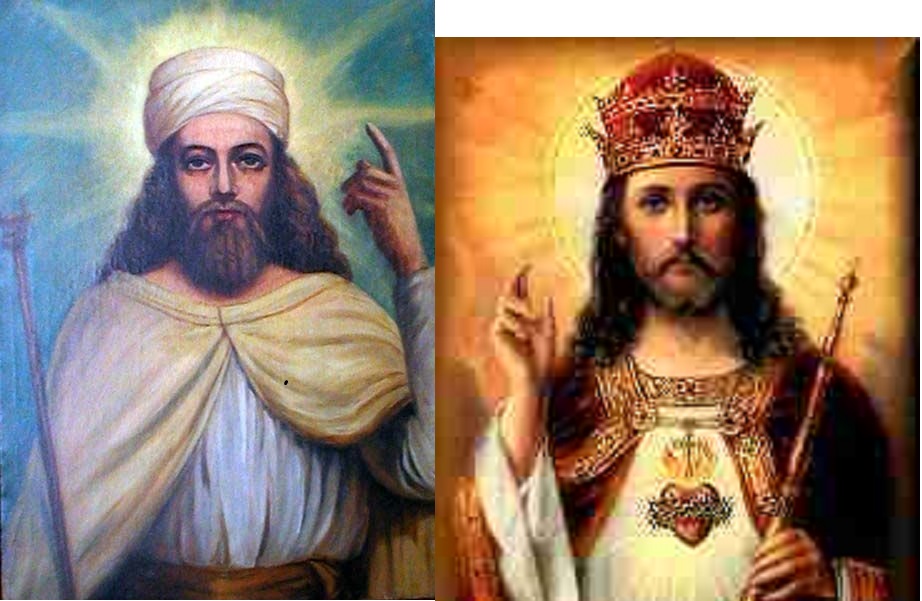
Zarathrustra and the Christian Christ


The Left is Zarathrustra the Right is the Christian Christ.

notice that both images are almost exactly alike. You can literally say that the Christians ripped off Zarathrustra and his teachings.

Zarathushtra Spitama or Ashu Zarathushtra was an ancient Iranian-speaking prophet whose teachings and innovations on the religious traditions of ancient Iranian-speaking peoples developed into the religion of Zoroastrianism, which by some accounts was the first world religion.
2nd millennium BCE

Jesus also referred to as Jesus of Nazareth and Jesus Christ, was a Jewish preacher and religious leader. He is the central figure of Christianity.
4 BC – c. 30/33 AD

Saturday, June 24, 2017

AĒŠMA (Zoroastrian demon)


AĒŠMA “wrath” in Younger Avestan: Gathic aēšəma-, Middle Persian (x)ēšm, Pāzand and New Persian ḵašm, ḵešm. (On the word’s root and its derivatives in Old Iranian and Old Indic, see F. Windischmann, Zoroastrische Studien, Berlin, 1863, p. 139; S. Wikander, Der arische Männerbund, Lund, 1938, pp. 59-60.) The term indicates wrath both metaphysically, as a distinct demon, and psychologically as the function and quality of that demon realized in man. The Avesta expresses abhorrence of Aēšma, for he endangers the integrity of the Good Religion of the Mazdayasnians. He distorts the intention and meaning of the sacrifice through brutality against cattle and violence in war and drunkenness (excluding the effect of haoma; see Yasna 10.8, Yašt 17.5). For the former point, see, in the Gāthās, Yasna29.1-2, 48.7, 49.4; cf. 30.6 on the daēvas’ running to Aēšma, “through whom men sicken life” (yā bąnayən ahūm marətānō; see R. Reitzenstein and H. H. Schaeder, Studien zum antiken Synkretismus aus Iran und Griechenland, Leipzig and Berlin, 1926 [repr. Darmstadt, 1965], p. 213). The yazata Sraoša, embodying religious obedience, discipline, and devotion, is the demon’s chief adversary in the Younger Avesta; and this divinity will overthrow him at the end of the world. (See Y. 57.10, 25; Yt. 11.15; Dādistān ī mēnōg ī xrad 7.14, ed. D. D. P. Sanjana, Bombay, 1895, p. 22.16; Pand-nāmag 38, ed. M. F. Kanga, Bombay, 1960, p. 8.4.) The function of smiting Aēšma is also ascribed to Mithra (Zand ī Wahman Yasn 7.34, ed. B. T. Anklesaria, Bombay, 1957, p. 67; cf. Yt. 10.97); this is due to the intimate connection between that divinity and Sraoša. (See also G. Messina, ed., Ayyātkār ī Žāmāspīk, Rome, 1939, 16.38; H. W. Bailey, “To the Žāmāsp-nāmak II,” BSOS 6, 1930-32, pp. 583, 588-89.) Aēšma is the messenger of Angra Mainyu, thus the negative counterpart of Spənta Mainyu’s Aša (Yt. 19.46; cf. Vd. 10.13 and 11.9, also Yt. 10.93 and 97, where he is mentioned together with other daēvas). Aēšma is especially afraid of the gāhānbār and myazd rites and of the pious practice of kin-marriage (xwēdōdah; Šāyast nē šāyast 18.1-3, ed. F. M. P. Kotwal, Copenhagen, 1969, pp. 76-77). At the last day he will flee before Saošyant Astvat.ərəta and his followers (Yt.19.95).

The Middle Persian Zoroastrian books supplement the Avesta’s picture of Aēšma, emphasizing the attitude of fear and dread of the demon and his power. He is like Ahriman (Mēnōg ī xrad 2.19; ed. Sanjana, p. 68.18). Xēšm comes to the material world once each night but is kept away by Srōš (Šāyast nē šāyast 13.43, 22.17; ed. Kotwal, pp. 52-53, 91). He is given seven powers, which he uses to destroy creatures (Bundahišn, p. 183.12ff.). Commissioned by Ahriman, he causes an increase in slaughter; and, if he can not sow discord among men, he even incites the demons to fight among themselves (Dādistān ī dēnīg, pp. 89.5ff., 104.10ff.). He is termed the opposite of Wahman (Pand-nāmag 27, ed. Kanga, p. 6.4.; Dēnkard 3.116, p. 112.18ff., tr. J. de Menasce, Le troisième livre du Dēnkart, Paris, 1973, p. 119) or of Srōš (Wizīrīhā ī dēn ī weh ī Mazdēsnān, ed. K. M. Jamasp Asa; W. B. Henning Memorial Volume, London, 1970, pp. 204, 207, 214.7-8). Xēšm has a close association with Waran, Āz (Lust), Desire, and Heresy; to help Āz, he was made commander of the east by Ahriman (Dēnkard, p. 206.13ff.; Zātspram 34.32, p. 143; cf. R. C. Zaehner, Zurvan. A Zoroastrian Dilemma, Oxford, 1955, p. 343ff.). Eventually Āz will swallow up Xēšm and the other commanders p. 155.5ff.; cf. Zaehner, Zurvan, pp. 182, 354). The great tyrants of Iranian legend were at least mortal; whereas, if power had been granted to the bodiless Xēšm, he would have ruled, immortal, until the Resurrection and the Final Body (Mēnōg ī xrad 27.36-37; ed. Sanjana, p. 45.19-22). Xēšm is one of the demons who assail the souls of the dead as these approach the Činvat Bridge for judgment (Mēnōg ī xrad 2.115.17).

In the apocalyptic books Xēšm represents one of the heaviest visitations of the latter times; his dēw progeny with disheveled hair are understood as the Arabs (see, e.g., Zand ī Wahman Yasn 4.3, pp. 17, 106; the identification as the Tāzīgān is explicit in Ayyātkār ī Žāmāspīk 15.28, p. 65). In the New Persian versions of the two texts just cited, the names Hēšm (hyšm) and Hāšem (hʾšm) are interchanged. This indicates a Zoroastrian interpretation of contemporary events in the fight of traditional apocalyptic speculation, identifying Ḵēšm/Hēšm with the Hāšemī branch of the Qorayš, and so with the Muslims generally. (See B. N. Dhabhar, The Persian Rivayats of Hormazyar Framarz and Others, Bombay, 1932, pp. 457ff., 481ff. Cf. also, perhaps, the Pāzand Ayyātkār, where the written form is hāēšəm; see S. Hartman, “Secrets for Muslims in Parsi Scriptures,” Islam and its Cultural Divergence, Urbana, 1970, pp. 68-71.) Thus Ḵēšm continued to be regarded seriously. A yasna rite not carried out properly is said to reach Ḵēšm just as if it had been performed for him (Darab Hormazyar’s Rivayat, Bombay, 1922, I, pp. 489.17-490.2; Dhabhar, Rivayats, pp. 335-36). He remained especially opposed to Srōš, with the function that “he throws anger and malice into the hearts of men and encourages every evil which enters the world and assists sinners, so that they become more fearless in sinning” (Ṣaddar Bondaheš 2.1 and 36, ed. Dhabhar, Bombay, 1909, pp. 70, 73; Dhabhar, Rivayats, pp. 505, 507).

Aēšma’s standing epithet is xrvi.dru- “of the bloody club” (AirWb., col. 540), rendered in Mid. Pers. as xurdruš; to this term is opposed Sraoša’s epithet, darši.dru- “of the strong (Ahurian) club” (ibid., col. 699). The demon’s other epithets include: dušxᵛarənah- “ill-fated” (Yt. 10.95), duždā(y)- “malignant” (Y.57.25, Yt. 10.97), drvant- “owner of falsehood” (Yt. 10.93), and pesō.tanū- “having his body forfeited” (Yt. 10.97). I. Gershevitch comments on this last that “it may be that this demon "owes his body" to Mithra "the Judge"” (The Avestan Hymn to Mithra, Cambridge, 1959, p. 247). It is rendered tanāpuhrag in Mid. Pers. (Dēnkard, p. 643.10-11; cf. H. S. Nyberg, A Manual of Pahlavi II, Wiesbaden, 1974, p. l91); the same passage also gives the epithet mūtag “destructive” (ibid., II, pp. 134-45).

Mani took over parts of Zoroastrian demonology in fashioning his gnostic religion, and Xēšm came to play a remarkable role as the active, destructive spirit of Āz (“Hyle”). The Parthian text M 741, on the seduction of the archons, relates: “The dirt and dross flows from him to the earth. It clothes itself in all phenomena (dīdan) and is reborn in many fruits. The dark Išmag (ʿšmg, i.e., Xēšm) is ashamed, for he was distraught and had become naked. He had not attained to the higher and had been bereft of what he had achieved. He left the body an empty shell and descended in shame. He was clothed in the womb of the earths, whence he rose in brutishness” (M. Boyce, “Sadwēs and Pēsūs,” BSOAS 13, 1951, p. 912; idem, A Reader in Manichaean Middle Persian and Parthian [Acta Iranica 9], Tehran and Liege, 1975, p. 99). He seems to have been the prototype for a class of negative powers, the “Wraths” (xēšmān, išmagān) sent by Satan. (See Mir. Man. I, pp. 182, 194; III, pp. 875, 879-80, 882, 887; cf. the term išmagšft “išmag-ism” in III, p. 880.) He also acted as an invisible power within man, the mēnōgīh of the body: wrath, desire (āz), and lust (āwaržōg; Mir. Man. II, p. 300; cf. I, pp. 196, 198ff.).

Outside the Iranian world, Aēšma occurs in the Talmud as ʾšmdʾy and in the Book of Tobit as Asmodaios (variant of Codex B: Asmódaus), both from Av. *aēšmō.daēva-. It has been argued against this derivation that such a compound is not actually found in the extant Avesta. But this is invalidated by the fact that only a very limited part of the Avestan corpus has been preserved; moreover Mid. Pers. “Xēšm Dēw” is attested in sources which reproduce older material (e.g., Bundahišn, p. 183.12; Dēnkard, p. 643.4). Nor does the claim that the name comes from Hebrew šmd hold good, for a meaning “destroyer” would seem to require a hifʿīlform of some kind. In the Book of Tobit (3:7ff.), Asmodaios figures as a demon who has slain each of the seven husbands of Sarah, daughter of Raquel, before any of the marriages was consummated. With the aid of the angel Raphael, the demon is at last defeated (8:3). This account does not contradict Aēšma’s Iranian role as representative of destructive activity; and other indications of Iranian influence in the Book of Tobit support the etymology.

Bibliography:

See also J. Müller, Beiträge zur Erklärung und Kritik des Buches Tobit (Beihefte zur Zeitschrift für die alttestamentliche Wissenschaft 13), Giessen, 1908, p. 10.

J. H. Moulton, Early Zoroastrianism, London, 1926, pp. 250ff.

A. V. W. Jackson, Zoroastrian Studies, New York, 1928, pp. 89-91.

Gray, Foundations, pp. 185-87.

Alexander Kohut, Additamenta ad Librum Aruch Completum, ed. S. Krauss, New York, 1955, p. 70.

W. O. E. Oesterley, An Introduction to the Books of the Apocrypha, London, 1958, pp. 166-67.

R. N. Frye, “Qumran and Iran,” Studies Dedicated to Morton Smith, ed. J. Neusner, Leiden, 1973, p. 170.