Food and the act of eating played an important part in the Greek mind.
Ancient Greek cuisine was characterized by its frugality, reflecting agricultural hardship. It was founded on the "Mediterranean triad": wheat, olive oil, and wine.
Meals
They also ate pancakes called τηγανίτης (tēganitēs), ταγηνίτης(tagēnitēs) or ταγηνίας(tagēnias), all words deriving from τάγηνον (tagēnon), "frying pan". The earliest attested references on tagenias are in the works of the 5th century BC poets Cratinus and Magnes.
Tagenites were made with wheat flour, olive oil, honey and curdled milk, and were served for breakfast.
Tagenites were made with wheat flour, olive oil, honey and curdled milk, and were served for breakfast.
Another kind of pancake was σταιτίτης (staititēs), from σταίτινος (staitinos), "of flour or dough of spelt", derived from σταῖς (stais), "flour of spelt". Athenaeus in his Deipnosophistae mentions staititas topped with honey, sesame and cheese.
A quick lunch (ἄριστον ariston) was taken around noon or early afternoon.
A quick lunch (ἄριστον ariston) was taken around noon or early afternoon.
Dinner (δεῖπνον deipnon), the most important meal of the day, was generally taken at nightfall.
An additional light meal (ἑσπέρισμα hesperisma) was sometimes taken in the late afternoon.Ἀριστόδειπνον / aristodeipnon, literally "lunch-dinner", was served in the late afternoon instead of dinner.
Men and women took their meals separately. When the house was too small, the men ate first, the women afterwards. Slaves waited at dinners. Aristotle notes that "the poor, having no slaves, would ask their wives or children to serve food." Respect for the father who was the breadwinner was obvious.
Men and women took their meals separately. When the house was too small, the men ate first, the women afterwards. Slaves waited at dinners. Aristotle notes that "the poor, having no slaves, would ask their wives or children to serve food." Respect for the father who was the breadwinner was obvious.
The ancient Greek custom of placing terra cotta miniatures of their furniture in children's graves gives us a good idea of its style and design. The Greeks normally ate while seated on chairs; benches were used for banquets. The tables, high for normal meals and low for banquets, were initially rectangular in shape.

By the 4th century BC, the usual table was round, often with animal-shaped legs (for example lion's paws). Loaves of flat bread could be used as plates, but terra cotta bowls were more common.
Dishes became more refined over time, and by the Roman period plates were sometimes made out of precious metals or glass. Cutlery was not often used at the table: use of the fork was unknown; people ate with their fingers. Knives were used to cut the meat.
Spoons were used for soups and broths. Pieces of bread (ἀπομαγδαλία apomagdalia) could be used to spoon the food or as napkins to wipe the fingers.
As with modern dinner parties, the host could simply invite friends or family; but two other forms of social dining were well documented in ancient Greece: the entertainment of the all-male symposium, and the obligatory, regimental syssitia.
The symposium (Greek: συμπόσιον symposion or symposio, from συμπίνειν sympinein, "to drink together") was a part of a banquet that took place after the meal, when drinking for pleasure was accompanied by music, dancing, recitals, or conversation.
Literary works that describe or take place at a symposium include two Socratic dialogues, Plato's Symposium and Xenophon's Symposium, as well as a number of Greek poems such as the elegies of Theognis of Megara. Symposia are depicted in Greek and Etruscan art that shows similar scenes.
Symposium
The symposium (Greek: συμπόσιον symposion or symposio, from συμπίνειν sympinein, "to drink together") was a part of a banquet that took place after the meal, when drinking for pleasure was accompanied by music, dancing, recitals, or conversation.
Literary works that describe or take place at a symposium include two Socratic dialogues, Plato's Symposium and Xenophon's Symposium, as well as a number of Greek poems such as the elegies of Theognis of Megara. Symposia are depicted in Greek and Etruscan art that shows similar scenes.
It consisted of two parts: the first dedicated to food, generally rather simple, and a second part dedicated to drinking. However, wine was consumed with the food, and the beverages were accompanied by snacks (τραγήματα tragēmata) such as chestnuts, beans, toasted wheat, or honey cakes, all intended to absorb alcohol and extend the drinking spree.
The second part was inaugurated with a libation, most often in honor of Dionysus, followed by conversation or table games, such as kottabos. The guests would recline on couches (κλίναι klinai); low tables held the food or game boards.
Dancers, acrobats, and musicians would entertain the wealthy banqueters. A "king of the banquet" was drawn by lots; he had the task of directing the slaves as to how strong to mix the wine.
With the exception of courtesans, the banquet was strictly reserved for men. It was an essential element of Greek social life. Great feasts could only be afforded by the rich; in most Greek homes, religious feasts or family events were the occasion of more modest banquets.
The banquet became the setting of a specific genre of literature, giving birth to Plato's Symposium, Xenophon's work of the same name, the Table Talk of Plutarch's Moralia, and the Deipnosophists (Banquet of the Learned) of Athenaeus.
The second part was inaugurated with a libation, most often in honor of Dionysus, followed by conversation or table games, such as kottabos. The guests would recline on couches (κλίναι klinai); low tables held the food or game boards.
Dancers, acrobats, and musicians would entertain the wealthy banqueters. A "king of the banquet" was drawn by lots; he had the task of directing the slaves as to how strong to mix the wine.
With the exception of courtesans, the banquet was strictly reserved for men. It was an essential element of Greek social life. Great feasts could only be afforded by the rich; in most Greek homes, religious feasts or family events were the occasion of more modest banquets.
The banquet became the setting of a specific genre of literature, giving birth to Plato's Symposium, Xenophon's work of the same name, the Table Talk of Plutarch's Moralia, and the Deipnosophists (Banquet of the Learned) of Athenaeus.
Setting and social occasion
 |
| Plato's Symposium, depiction by Anselm Feuerbach |
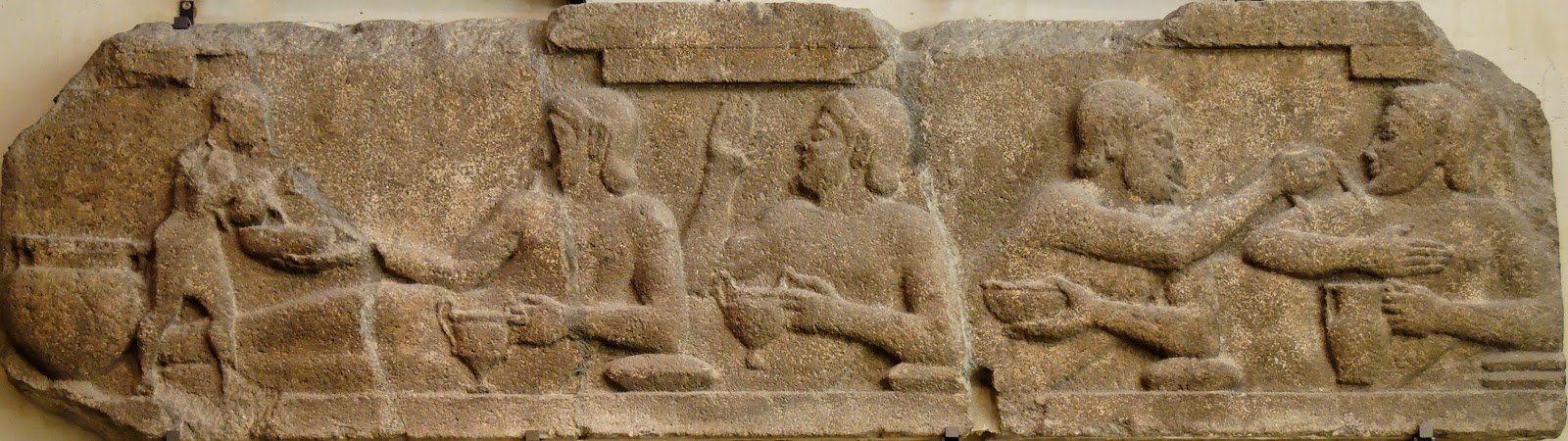 |
| Banquet scene from a Temple of Athena (6th century BC relief). |
Symposia were usually held in the andrōn (ἀνδρών), the men's quarters of the household. The participants, or "symposiasts", would recline on pillowed couches arrayed against the three walls of the room away from the door.
Due to space limitations, the couches would number between seven and nine, limiting the total number of participants to somewhere between fourteen and twenty seven (Oswyn Murray gives a figure of between seven and fifteen couches and reckons fourteen to thirty participants a "standard size for a drinking group").
If any young men took part, they did not recline but sat up. However, in Macedonian symposia, the focus was not only on drinking but hunting, and young men were allowed to recline only after they had killed their first wild boar.
Food and wine were served. Entertainment was provided, and depending on the occasion could include games, songs, flute-girls or boys, slaves performing various acts, and hired entertainment.
Symposia often were held for specific occasions. The most famous symposium of all, described in Plato's dialogue of that name (and rather differently in Xenophon's) was hosted by the poet Agathon on the occasion of his first victory at the theater contest of the 416 BC Dionysia. According to Plato's account, the celebration was upstaged by the unexpected entrance of the toast of the town, the young Alcibiades, dropping in drunken and nearly naked, having just left another symposium.
The men at the symposium would discuss a multitude of topics—often philosophical, such as love and the differences between genders.
Drinking
A symposium would be overseen by a "symposiarch" who would decide how strong the wine for the evening would be, depending on whether serious discussions or merely sensual indulgence were in the offing. The Greeks and Romans customarily served their wine mixed with water, as the drinking of pure wine was considered a habit of uncivilized peoples.
However, there were major differences between the Roman and Greek symposia.
A Roman symposium (convivium) served wine before, with and after food, and women were allowed to join. In a Greek symposium, wine was only drunk after dinner, and women were not allowed to attend.
 |
| A female aulos-player entertains men at a symposium on this Attic red-figure bell-krater, c. 420 BC |
The wine was drawn from a krater, a large jar designed to be carried by two men, and served from pitchers (oenochoe). Determined by the Master of Ceremonies, the wine was diluted to a specific strength and was then mixed.
Slave boys would manage the krater, and transfer the wine into pitchers. They then attended to each man in the symposium with the pitchers and filled their cups with wine. Certain formalities were observed, most important among which were libations, the pouring of a small amount of wine in honor of various deities or the mourned dead.
In a fragment from his c. 375 BC play Semele or Dionysus, Eubulus has the god of wine Dionysos describe proper and improper drinking:
For sensible men I prepare only three kraters: one for health (which they drink first), the second for love and pleasure, and the third for sleep. After the third one is drained, wise men go home.
The fourth krater is not mine any more - it belongs to bad behavior; the fifth is for shouting; the sixth is for rudeness and insults; the seventh is for fights; the eighth is for breaking the furniture; the ninth is for depression; the tenth is for madness and unconsciousness.
In keeping with the Greek virtue of moderation, the symposiarch should have prevented festivities from getting out of hand, but Greek literature and art often indicate that the third-krater limit was not observed.
Classicist John Wilkins notes that "in the Odyssey for example, good men are distinguished from bad and Greeks from foreigners partly in terms of how and what they ate. Herodotus identified people partly in terms of food and eating".
Up to the 3rd century BC, the frugality imposed by the physical and climatic conditions of the country was held as virtuous. The Greeks did not ignore the pleasures of eating, but valued simplicity. The rural writer Hesiod, as cited above, spoke of his "flesh of a heifer fed in the woods, that has never calved, and of firstling kids" as being the perfect closing to a day. Nonetheless, Chrysippus is quoted as saying that the best meal was a free one.
Culinary and gastronomical research was rejected as a sign of oriental flabbiness: the inhabitants of the Persian Empire were considered decadent due to their luxurious taste, which manifested itself in their cuisine.
The Greek authors took pleasure in describing the table of the Achaemenid Great King and his court: Herodotus, Clearchus of Soli, Strabo and Ctesias were unanimous in their descriptions.
In consequence of this cult of frugality, and the diminished regard for cuisine it inspired, the kitchen long remained the domain of women, free or enslaved.
In the classical period, however, culinary specialists began to enter the written record. Both Aelian and Athenaeus mention the thousand cooks who accompanied Smindyride of Sybaris on his voyage to Athens at the time of Cleisthenes, if only disapprovingly.
In contrast, Greeks as a whole stressed the austerity of their own diet. Plutarch tells how the king of Pontus, eager to try the Spartan "black gruel", bought a Laconian cook; 'but had no sooner tasted it than he found it extremely bad, which the cook observing, told him, "Sir, to make this broth relish, you should have bathed yourself first in the river Eurotas"'.
According to Polyaenus, on discovering the dining hall of the Persian royal palace, Alexander the Great mocked their taste and blamed it for their defeat. Pausanias, on discovering the dining habits of the Persian commander Mardonius, equally ridiculed the Persians, "who having so much, came to rob the Greeks of their miserable living".
Plato in Gorgias, mentions "Thearion the cook, Mithaecus the author of a treatise on Sicilian cooking, and Sarambos the wine merchant; three eminent connoisseurs of cake, kitchen and wine." Some chefs also wrote treatises on cuisine.
Over time, more and more Greeks presented themselves as gourmets. From the Hellenistic to the Roman period, the Greeks — at least the rich — no longer appeared to be any more austere than others. The cultivated guests of the feast hosted by Athenaeus in the 2nd or 3rd century devoted a large part of their conversation to wine and gastronomy.
They discussed the merits of various wines, vegetables, and meats, mentioning renowned dishes (stuffed cuttlefish, red tuna belly, prawns, lettuce watered with mead) and great cooks such as Soterides, chef to king Nicomedes I of Bithynia (who reigned from the 279 to 250 BC).
When his master was inland, he pined for anchovies; Soterides simulated them from carefully carved turnips, oiled, salted and sprinkled with poppy seeds.
Cereals formed the staple diet. The two main grains were wheat (σῖτος sitos) and barley (κριθή krithe).
In ancient Greece, bread was served with accompaniments known as opson ὄψον, sometimes rendered in English as "relish".[30] This was a generic term which referred to anything which accompanied this staple food, whether meat or fish, fruit or vegetable.
Up to the 3rd century BC, the frugality imposed by the physical and climatic conditions of the country was held as virtuous. The Greeks did not ignore the pleasures of eating, but valued simplicity. The rural writer Hesiod, as cited above, spoke of his "flesh of a heifer fed in the woods, that has never calved, and of firstling kids" as being the perfect closing to a day. Nonetheless, Chrysippus is quoted as saying that the best meal was a free one.
Culinary and gastronomical research was rejected as a sign of oriental flabbiness: the inhabitants of the Persian Empire were considered decadent due to their luxurious taste, which manifested itself in their cuisine.
The Greek authors took pleasure in describing the table of the Achaemenid Great King and his court: Herodotus, Clearchus of Soli, Strabo and Ctesias were unanimous in their descriptions.
In consequence of this cult of frugality, and the diminished regard for cuisine it inspired, the kitchen long remained the domain of women, free or enslaved.
In the classical period, however, culinary specialists began to enter the written record. Both Aelian and Athenaeus mention the thousand cooks who accompanied Smindyride of Sybaris on his voyage to Athens at the time of Cleisthenes, if only disapprovingly.
In contrast, Greeks as a whole stressed the austerity of their own diet. Plutarch tells how the king of Pontus, eager to try the Spartan "black gruel", bought a Laconian cook; 'but had no sooner tasted it than he found it extremely bad, which the cook observing, told him, "Sir, to make this broth relish, you should have bathed yourself first in the river Eurotas"'.
According to Polyaenus, on discovering the dining hall of the Persian royal palace, Alexander the Great mocked their taste and blamed it for their defeat. Pausanias, on discovering the dining habits of the Persian commander Mardonius, equally ridiculed the Persians, "who having so much, came to rob the Greeks of their miserable living".
Plato in Gorgias, mentions "Thearion the cook, Mithaecus the author of a treatise on Sicilian cooking, and Sarambos the wine merchant; three eminent connoisseurs of cake, kitchen and wine." Some chefs also wrote treatises on cuisine.
Over time, more and more Greeks presented themselves as gourmets. From the Hellenistic to the Roman period, the Greeks — at least the rich — no longer appeared to be any more austere than others. The cultivated guests of the feast hosted by Athenaeus in the 2nd or 3rd century devoted a large part of their conversation to wine and gastronomy.
They discussed the merits of various wines, vegetables, and meats, mentioning renowned dishes (stuffed cuttlefish, red tuna belly, prawns, lettuce watered with mead) and great cooks such as Soterides, chef to king Nicomedes I of Bithynia (who reigned from the 279 to 250 BC).
When his master was inland, he pined for anchovies; Soterides simulated them from carefully carved turnips, oiled, salted and sprinkled with poppy seeds.
Bread
 |
| Woman kneading bread, c. 500–475 BC, National Archaeological Museum of Athens |
Cereals formed the staple diet. The two main grains were wheat (σῖτος sitos) and barley (κριθή krithe).
In ancient Greece, bread was served with accompaniments known as opson ὄψον, sometimes rendered in English as "relish".[30] This was a generic term which referred to anything which accompanied this staple food, whether meat or fish, fruit or vegetable.
Wheat
Wheat grains were softened by soaking, then either reduced into gruel, or ground into flour (ἀλείατα aleiata) and kneaded and formed into loaves (ἄρτος artos) or flatbreads, either plain or mixed with cheese or honey. Leavening was known; the Greeks later used an alkali (νίτρον nitron) and wine yeast as leavening agents. Dough loaves were baked at home in a clay oven (ἰπνός ipnos) set on legs.
Bread wheat, difficult to grow in Mediterranean climates, and the white bread made from it, were associated with the upper classes in the ancient Mediterranean, while the poor ate coarse brown breads made from emmer wheat and barley.
A simpler baking method involved placing lighted coals on the floor and covering the heap with a dome-shaped lid (πνιγεύς pnigeus); when it was hot enough, the coals were swept aside, and dough loaves were placed on the warm floor. The lid wasthen put back in place, and the coals were gathered on the side of the cover. (This method is still traditionally used in Serbia and elsewhere in the Balkans, where it is called crepulja or sač). The stone oven did not appear until the Roman period. Solon, an Athenian lawmaker of the 6th century BC, prescribed that leavened bread be reserved for feast days. By the end of the 5th century BC, leavened bread was sold at the market, though it was expensive.
Barley
Barley was easier to produce but more difficult to make bread from. It provided a nourishing but very heavy bread. Because of this it was often roasted before milling, producing a coarse flour (ἄλφιτα alphita) which was used to make μᾶζα maza, the basic Greek dish. Many recipes for maza are known; it could be served cooked or raw, as a broth, or made into dumplings or flatbreads. Like wheat breads, it could also be augmented with cheese or honey.
In Peace, Aristophanes employs the expression ἐσθίειν κριθὰς μόνας, literally "to eat only barley", with a meaning equivalent to the English "diet of bread and water".
Fruit and vegetables
In ancient Greece, fruit and vegetables were a significant part of the diet, as the ancient Greeks consumed much less meat than is usual today. Legumes would have been important crops, as their ability to replenish exhausted soil was known at least by the time of Xenophon. As one of the first domesticated crops to be introduced to Greece, lentils are commonly found at archaeological sites in the region from the Upper Paleolithic.
Vegetables were eaten as soups, boiled or mashed (ἔτνος etnos), seasoned with olive oil, vinegar, herbs or γάρον gáron, a fish sauce similar to Vietnamese nước mắm. In the comedies of Aristophanes, Heracles was portrayed as a glutton with a fondness for mashed beans. Poor families ate oak acorns (βάλανοι balanoi). Raw or preserved olives were a common appetizer.
In the cities, fresh vegetables were expensive, and therefore, the poorer city dwellers had to make do with dried vegetables. Lentil soup (φακῆ phakē) was the workman's typical dish. Cheese, garlic, and onions were the soldier's traditional fare. In Aristophanes' Peace, the smell of onions typically represents soldiers; the chorus, celebrating the end of war, sings Oh! joy, joy! No more helmet, no more cheese nor onions! Bitter vetch (ὄροβος orobos) was considered a famine food.
Fruits, fresh or dried, and nuts, were eaten as dessert. Important fruits were figs, raisins, and pomegranates. In Athenaeus' Deipnosophistae, he describes a dessert made of figs and broad beans. Dried figs were also eaten as an appetizer or when drinking wine. In the latter case, they were often accompanied by grilled chestnuts, chick peas, and beechnuts.
Fish and meat
 |
| Sacrifice; principal source of meat for city dwellers here a boar; tondo of an Attickylix by the Epidromos Painter, c. 510–500 BC, Louvre. |
The consumption of fish and meat varied in accordance with the wealth and location of the household; in the country, hunting (primarily trapping) allowed for consumption of birds and hares. Peasants also had farmyards to provide them with chickens and geese. Slightly wealthier landowners could raise goats, pigs, or sheep. In the city, meat was expensive except for pork. In Aristophanes' day a piglet cost three drachmas, which was three days' wages for a public servant. Sausages were common both for the poor and the rich. Archaeological excavations at Kavousi Kastro, Lerna, and Kastanas have shown that dogs were sometimes consumed in Bronze Age Greece, in addition to the more commonly-consumed pigs, cattle, sheep, and goats.
In the 8th century BC Hesiod describes the ideal country feast in Works and Days:
Meat is much less prominent in texts of the 5th century BC onwards than in the earliest poetry, but this may be a matter of genre rather than real evidence of changes in farming and food customs. Fresh meat was most commonly eaten at sacrifices, though sausage was much more common, consumed by people across the economic spectrum.
Spartans primarily ate a soup made from pigs' legs and blood, known as melas zōmos (μέλας ζωμός), which means "black soup". According to Plutarch, it was "so much valued that the elderly men fed only upon that, leaving what flesh there was to the younger". It was famous amongst the Greeks. "Naturally Spartans are the bravest men in the world," joked a Sybarite, "anyone in his senses would rather die ten thousand times than take his share of such a sorry diet". It was made with pork, salt, vinegar and blood. The dish was served with maza, figs and cheese sometimes supplemented with game and fish. The 2nd–3rd century author Aelian claims that Spartan cooks were prohibited from cooking anything other than meat.
In the Greek islands and on the coast, fresh fish and seafood (squid, octopus, and shellfish) were common. They were eaten locally but more often transported inland. Sardines and anchovies were regular fare for the citizens of Athens. They were sometimes sold fresh, but more frequently salted. A stele of the late 3rd century BC from the small Boeotian city of Akraiphia, on Lake Copais, provides us with a list of fish prices. The cheapest was skaren (probably parrotfish) whereas Atlantic bluefin tuna was three times as expensive. Common salt water fish were yellowfin tuna, red mullet, ray, swordfish or sturgeon, a delicacy which was eaten salted. Lake Copais itself was famous in all Greece for its eels, celebrated by the hero of The Acharnians. Other fresh water fish were pike-fish, carp and the less appreciated catfish. In classical Athens, eels, conger-eels, and sea-perch (ὈρΦὸς) were considered to be great delicacies, while sprats were cheap and readily available.
In the 8th century BC Hesiod describes the ideal country feast in Works and Days:
“But at that time let me have a shady rock and Bibline wine, a clot of curds and milk of drained goats with the flesh of a heifer fed in the woods, that has never calved, and of firstling kids; then also let me drink bright wine…”
Meat is much less prominent in texts of the 5th century BC onwards than in the earliest poetry, but this may be a matter of genre rather than real evidence of changes in farming and food customs. Fresh meat was most commonly eaten at sacrifices, though sausage was much more common, consumed by people across the economic spectrum.
Spartans primarily ate a soup made from pigs' legs and blood, known as melas zōmos (μέλας ζωμός), which means "black soup". According to Plutarch, it was "so much valued that the elderly men fed only upon that, leaving what flesh there was to the younger". It was famous amongst the Greeks. "Naturally Spartans are the bravest men in the world," joked a Sybarite, "anyone in his senses would rather die ten thousand times than take his share of such a sorry diet". It was made with pork, salt, vinegar and blood. The dish was served with maza, figs and cheese sometimes supplemented with game and fish. The 2nd–3rd century author Aelian claims that Spartan cooks were prohibited from cooking anything other than meat.
In the Greek islands and on the coast, fresh fish and seafood (squid, octopus, and shellfish) were common. They were eaten locally but more often transported inland. Sardines and anchovies were regular fare for the citizens of Athens. They were sometimes sold fresh, but more frequently salted. A stele of the late 3rd century BC from the small Boeotian city of Akraiphia, on Lake Copais, provides us with a list of fish prices. The cheapest was skaren (probably parrotfish) whereas Atlantic bluefin tuna was three times as expensive. Common salt water fish were yellowfin tuna, red mullet, ray, swordfish or sturgeon, a delicacy which was eaten salted. Lake Copais itself was famous in all Greece for its eels, celebrated by the hero of The Acharnians. Other fresh water fish were pike-fish, carp and the less appreciated catfish. In classical Athens, eels, conger-eels, and sea-perch (ὈρΦὸς) were considered to be great delicacies, while sprats were cheap and readily available.
Eggs and dairy products
Greeks bred quails and hens, partly for their eggs. Some authors also praise pheasant eggs and Egyptian Goose eggs, which were presumably rather rare. Eggs were cooked soft- or hard-boiled as hors d'œuvre or dessert. Whites, yolks and whole eggs were also used as ingredients in the preparation of dishes.
Country dwellers drank milk (γάλα gala), but it was seldom used in cooking. Butter (βούτυρον bouturon) was known but seldom used either:
Greeks saw it as a culinary trait of the Thracians of the northern Aegean coast, whom the Middle Comic poet Anaxandrides dubbed "butter eaters".
Yet Greeks enjoyed other dairy products. Πυριατή pyriatē and Oxygala (οξύγαλα) were curdled milk products, similar to cottage cheese or perhaps to yogurt.
Most of all, goat's and ewe's cheese (τυρός tyros) was a staple food. Fresh and hard cheese were sold in different shops; the former cost about two thirds of the latter's price.
Cheese was eaten alone or with honey or vegetables. It was also used as an ingredient in the preparation of many dishes, including fish dishes. The only extant recipe by the Sicilian cook Mithaecus runs: "Tainia: gut, discard the head, rinse and fillet; add cheese and olive oil".
Cheese was eaten alone or with honey or vegetables. It was also used as an ingredient in the preparation of many dishes, including fish dishes. The only extant recipe by the Sicilian cook Mithaecus runs: "Tainia: gut, discard the head, rinse and fillet; add cheese and olive oil".
However, the addition of cheese seems to have been a controversial matter; Archestratus warns his readers that Syracusan cooks spoil good fish by adding cheese.
The most widespread drink was water. Fetching water was a daily task for women. Though wells were common, spring water was preferred: it was recognized as nutritious because it caused plants and trees to grow, and also as a desirable beverage. Pindar called spring water "as agreeable as honey".
One of the comic poet Antiphanes's characters claimed that he could recognize Attic water by taste alone. Athenaeus states that a number of philosophers had a reputation for drinking nothing but water, a habit combined with a vegetarian diet (cf. below). Milk, usually goats' milk, was not widely consumed, being considered barbaric.
Drink
 |
| Attic Rhyton, c. 460–450 BC, National Archaeological Museum of Athens. |
One of the comic poet Antiphanes's characters claimed that he could recognize Attic water by taste alone. Athenaeus states that a number of philosophers had a reputation for drinking nothing but water, a habit combined with a vegetarian diet (cf. below). Milk, usually goats' milk, was not widely consumed, being considered barbaric.
The usual drinking vessel was the skyphos, made out of wood, terra cotta, or metal. Critias[81] also mentions the kothon, a Spartan goblet which had the military advantage of hiding the colour of the water from view and trapping mud in its edge. The ancient Greeks also used a vessel called a kylix (a shallow footed bowl), and for banquets the kantharos (a deep cup with handles) or the rhyton, a drinking horn often moulded into the form of a human or animal head.
Wine
The Greeks are thought to have made red as well as rosé and white wines. Like today, these varied in quality from common table wine to valuable vintages. It was generally considered that the best wines came from Thásos, Lesbos and Chios.
Cretan wine came to prominence later. A secondary wine made from water and pomace (the residue from squeezed grapes), mixed with lees, was made by country people for their own use. The Greeks sometimes sweetened their wine with honey and made medicinal wines by adding thyme, pennyroyal and other herbs. By the first century, if not before, they were familiar with wine flavoured with pine resin (modern retsina). Aelian also mentions a wine mixed with perfume. Cooked wine was known, as well as a sweet wine from Thásos, similar to port wine.
Wine was generally cut with water. The drinking of akraton or "unmixed wine", though known to be practised by northern barbarians, was thought likely to lead to madness and death. Wine was mixed in a krater, from which the slaves would fill the drinker's kylix with an oinochoe (jugs). Wine was also thought to have medicinal powers. Aelian mentions that the wine from Heraia in Arcadia rendered men foolish but women fertile; conversely, Achaean wine was thought to induce abortion.
Outside of these therapeutic uses, Greek society did not approve of women drinking wine. According to Aelian, a Massalian law prohibited this and restricted women to drinking water. Sparta was the only city where women routinely drank wine.
Wine reserved for local use was kept in skins. That destined for sale was poured into πίθοι pithoi, (large terra cotta jugs). From here they were decanted into amphoras sealed with pitch for retail sale. Vintage wines carried stamps from the producers or city magistrates who guaranteed their origin. This is one of the first instances of indicating the geographical or qualitative provenance of a product.
Kykeon
 |
| Hecamede preparing kykeon for Nestor, kylix by the Brygos Painter, ca. 490 BC, Louvre |
Used as a ritual beverage in the Eleusinian Mysteries, kykeon was also a popular beverage, especially in the countryside: Theophrastus, in his Characters, describes a boorish peasant as having drunk much kykeon and inconveniencing the Assemblywith his bad breath. It also had a reputation as a good digestive, and as such, in Peace, Hermes recommends it to the main character who has eaten too much dried fruit.
Cultural beliefs about the role of food
Food played an important part in the Greek mode of thought. Classicist John Wilkins notes that "in the Odyssey for example, good men are distinguished from bad and Greeks from foreigners partly in terms of how and what they ate. Herodotus identified people partly in terms of food and eating".
Up to the 3rd century BC, the frugality imposed by the physical and climatic conditions of the country was held as virtuous. The Greeks did not ignore the pleasures of eating, but valued simplicity.
The rural writer Hesiod, as cited above, spoke of his "flesh of a heifer fed in the woods, that has never calved, and of firstling kids" as being the perfect closing to a day. Nonetheless, Chrysippus is quoted as saying that the best meal was a free one.
Culinary and gastronomical research was rejected as a sign of oriental flabbiness: the inhabitants of the Persian Empire were considered decadent due to their luxurious taste, which manifested itself in their cuisine.
Culinary and gastronomical research was rejected as a sign of oriental flabbiness: the inhabitants of the Persian Empire were considered decadent due to their luxurious taste, which manifested itself in their cuisine.
The Greek authors took pleasure in describing the table of the Achaemenid Great King and his court: Herodotus, Clearchus of Soli,Strabo and Ctesias were unanimous in their descriptions.
In contrast, Greeks as a whole stressed the austerity of their own diet. Plutarch tells how the king of Pontus, eager to try the Spartan "black gruel", bought a Laconian cook; 'but had no sooner tasted it than he found it extremely bad, which the cook observing, told him, "Sir, to make this broth relish, you should have bathed yourself first in the river Eurotas"'.
 |
| Fresh fish, one of the favorite dishes of the Greeks, platter with red figures, c. 350–325 BC, Louvre |
According to Polyaenus, on discovering the dining hall of the Persian royal palace, Alexander the Great mocked their taste and blamed it for their defeat. Pausanias, on discovering the dining habits of the Persian commander Mardonius, equally ridiculed the Persians, "who having so much, came to rob the Greeks of their miserable living".
In consequence of this cult of frugality, and the diminished regard for cuisine it inspired, the kitchen long remained the domain of women, free or enslaved. In the classical period, however, culinary specialists began to enter the written record.
In consequence of this cult of frugality, and the diminished regard for cuisine it inspired, the kitchen long remained the domain of women, free or enslaved. In the classical period, however, culinary specialists began to enter the written record.
Both Aelian and Athenaeus mention the thousand cooks who accompanied Smindyride of Sybaris on his voyage to Athens at the time of Cleisthenes, if only disapprovingly.
Plato in Gorgias, mentions "Thearion the cook, Mithaecus the author of a treatise on Sicilian cooking, and Sarambos the wine merchant; three eminent connoisseurs of cake, kitchen and wine." Some chefs also wrote treatises on cuisine.
Over time, more and more Greeks presented themselves as gourmets. From the Hellenistic to the Roman period, the Greeks — at least the rich — no longer appeared to be any more austere than others. The cultivated guests of the feast hosted by Athenaeus in the 2nd or 3rd century devoted a large part of their conversation to wine and gastronomy.
Over time, more and more Greeks presented themselves as gourmets. From the Hellenistic to the Roman period, the Greeks — at least the rich — no longer appeared to be any more austere than others. The cultivated guests of the feast hosted by Athenaeus in the 2nd or 3rd century devoted a large part of their conversation to wine and gastronomy.
They discussed the merits of various wines, vegetables, and meats, mentioning renowned dishes (stuffed cuttlefish, red tuna belly, prawns, lettuce watered with mead) and great cooks such as Soterides, chef to king Nicomedes I of Bithynia (who reigned from the 279 to 250 BC). When his master was inland, he pined for anchovies; Soterides simulated them from carefully carved turnips, oiled, salted and sprinkled with poppy seeds.
Suidas (an encyclopaedia from the Byzantine period) mistakenly attributes this exploit to the celebrated Roman gourmet Apicius (1st century BC) — which may be taken as evidence that the Greeks had reached the same level as the Romans.
Vegetarianism
 |
| Triptolemus received wheat sheaves from Demeter and blessings from Persephone, 5th century BC relief, National Archaeological Museum of Athens |
Empedocles (5th century BC) justified vegetarianism by a belief in the transmigration of souls: who could guarantee that an animal about to be slaughtered did not house the soul of a human being? However, it can be observed that Empedocles also included plants in this transmigration, thus the same logic should have applied to eating them. Vegetarianism was also a consequence of a dislike for killing: "For Orpheus taught us rights and to refrain from killing".
The information from Pythagoras (6th century BC) is more difficult to define. The Comedic authors such as Aristophanes and Alexis described Pythagoreans as strictly vegetarian, with some of them living on bread and water alone. Other traditions contented themselves with prohibiting the consumption of certain vegetables, such as the broad bean, or of sacred animals such as the white cock or selected animal parts.
It follows that vegetarianism and the idea of ascetic purity were closely associated, and often accompanied by sexual abstinence. In On the eating of flesh, Plutarch (1st–2nd century) elaborated on the barbarism of blood-spilling; inverting the usual terms of debate, he asked the meat-eater to justify his choice.
The Neoplatonic Porphyrius (3rd century) associates in On Abstinence vegetarianism with the Cretan mystery cults, and gives a census of past vegetarians, starting with the semi-mythical Epimenides. For him, the origin of vegetarianism was Demeter's gift of wheat to Triptolemus so that he could teach agriculture to humanity. His three commandments were: "Honour your parents", "Honour the gods with fruit", and "Spare the animals".