“All things manifesting in the lower worlds exist first in
the intangible rings of the upper spheres,
so that creation is, in truth,
the process of making tangible the intangible
by extending the intangible into various vibratory rates.”

― Manly P. Hall

The Qabbalah, the Secret Doctrine of Israel

Translate

Due to the changes and updates being done this section is going to change

Search the archive


Welcome Traveler to My Little Occultshop

Welcome Traveler,


It's been a whirlwind of a month, I can't say thank you enough for your support, starting next month I'll be putting out a monthly magazine about topics related to that month.


So what's new

I've added a new section that covers meals of the ancient world and a section about herbal remedies will be coming soon.


As always may your travels be light and your path be pleasant to you and your family, blessings.


Magus

Featured Sponsors

Here is what's new

Yeah I know its been 3 years since I've posted anything new. I burnt out from everything I was putting into this. and tbh what made me come back was the fact that even after 3 years this is still popular. I can't thank you enough for your continued support.

So what's new well I have a new address and with covid I've had a bit of free time. so maybe its time I got back into the captains chair and got to setting a course to places undiscovered. A part of me is happy while a part isn't because he know what's up and he doesn't like doing the hard long hours of labor.

Most popular post

My latest post on my Facebook Page My Little Occult Shop

  Its been what 2 possibly 3 years since I last posted. Burn out is what happened. I got so overwhelmed with everything that it just got to ...

Showing posts with label christmas. Show all posts

Saturday, November 25, 2017

Christmas an Ancient Holiday


Christmas is both a sacred religious holiday and a worldwide cultural and commercial phenomenon. For two millennia, people around the world have been observing it with traditions and practices that are both religious and secular in nature. Christians celebrate Christmas Day as the anniversary of the birth of Jesus of Nazareth, a spiritual leader whose teachings form the basis of their religion. Popular customs include exchanging gifts, decorating Christmas trees, attending church, sharing meals with family and friends and, of course, waiting for Santa Claus to arrive. December 25–Christmas Day–has been a federal holiday in the United States since 1870.


AN ANCIENT HOLIDAY


The middle of winter has long been a time of celebration around the world. Centuries before the arrival of the man called Jesus, early Europeans celebrated light and birth in the darkest days of winter. Many peoples rejoiced during the winter solstice, when the worst of the winter was behind them and they could look forward to longer days and extended hours of sunlight.

In Scandinavia, the Norse celebrated Yule from December 21, the winter solstice, through January. In recognition of the return of the sun, fathers and sons would bring home large logs, which they would set on fire. The people would feast until the log burned out, which could take as many as 12 days. The Norse believed that each spark from the fire represented a new pig or calf that would be born during the coming year.

The end of December was a perfect time for celebration in most areas of Europe. At that time of year, most cattle were slaughtered so they would not have to be fed during the winter. For many, it was the only time of year when they had a supply of fresh meat. In addition, most wine and beer made during the year was finally fermented and ready for drinking.

In Germany, people honored the pagan god Odin during the mid-winter holiday. Germans were terrified of Odin, as they believed he made nocturnal flights through the sky to observe his people, and then decide who would prosper or perish. Because of his presence, many people chose to stay inside.


SATURNALIA


In Rome, where winters were not as harsh as those in the far north, Saturnalia—a holiday in honor of Saturn, the god of agriculture—was celebrated. Beginning in the week leading up to the winter solstice and continuing for a full month, Saturnalia was a hedonistic time, when food and drink were plentiful and the normal Roman social order was turned upside down. For a month, slaves would become masters. Peasants were in command of the city. Business and schools were closed so that everyone could join in the fun.

Also around the time of the winter solstice, Romans observed Juvenalia, a feast honoring the children of Rome. In addition, members of the upper classes often celebrated the birthday of Mithra, the god of the unconquerable sun, on December 25. It was believed that Mithra, an infant god, was born of a rock. For some Romans, Mithra’s birthday was the most sacred day of the year.

In the early years of Christianity, Easter was the main holiday; the birth of Jesus was not celebrated. In the fourth century, church officials decided to institute the birth of Jesus as a holiday. 

Unfortunately, the Bible does not mention date for his birth (a fact Puritans later pointed out in order to deny the legitimacy of the celebration). Although some evidence suggests that his birth may have occurred in the spring (why would shepherds be herding in the middle of winter?), Pope Julius I chose December 25. It is commonly believed that the church chose this date in an effort to adopt and absorb the traditions of the pagan Saturnalia festival. First called the Feast of the Nativity, the custom spread to Egypt by 432 and to England by the end of the sixth century. By the end of the eighth century, the celebration of Christmas had spread all the way to Scandinavia. Today, in the Greek and Russian orthodox churches, Christmas is celebrated 13 days after the 25th, which is also referred to as the Epiphany or Three Kings Day. This is the day it is believed that the three wise men finally found Jesus in the manger.

By holding Christmas at the same time as traditional winter solstice festivals, church leaders increased the chances that Christmas would be popularly embraced, but gave up the ability to dictate how it was celebrated. By the Middle Ages, Christianity had, for the most part, replaced pagan religion. On Christmas, believers attended church, then celebrated raucously in a drunken, carnival-like atmosphere similar to today’s Mardi Gras. Each year, a beggar or student would be crowned the “lord of misrule” and eager celebrants played the part of his subjects. The poor would go to the houses of the rich and demand their best food and drink. If owners failed to comply, their visitors would most likely terrorize them with mischief. Christmas became the time of year when the upper classes could repay their real or imagined “debt” to society by entertaining less fortunate citizens.


AN OUTLAW CHRISTMAS

In the early 17th century, a wave of religious reform changed the way Christmas was celebrated in Europe. When Oliver Cromwell and his Puritan forces took over England in 1645, they vowed to rid England of decadence and, as part of their effort, cancelled Christmas. By popular demand, Charles II was restored to the throne and, with him, came the return of the popular holiday.

The pilgrims, English separatists that came to America in 1620, were even more orthodox in their Puritan beliefs than Cromwell. As a result, Christmas was not a holiday in early America. From 1659 to 1681, the celebration of Christmas was actually outlawed in Boston. Anyone exhibiting the Christmas spirit was fined five shillings. By contrast, in the Jamestown settlement, Captain John Smith reported that Christmas was enjoyed by all and passed without incident.

After the American Revolution, English customs fell out of favor, including Christmas. In fact, Christmas wasn’t declared a federal holiday until June 26, 1870.


IRVING REINVENTS CHRISTMAS


It wasn’t until the 19th century that Americans began to embrace Christmas. Americans re-invented Christmas, and changed it from a raucous carnival holiday into a family-centered day of peace and nostalgia. But what about the 1800s peaked American interest in the holiday?

The early 19th century was a period of class conflict and turmoil. During this time, unemployment was high and gang rioting by the disenchanted classes often occurred during the Christmas season. In 1828, the New York city council instituted the city’s first police force in response to a Christmas riot. This catalyzed certain members of the upper classes to begin to change the way Christmas was celebrated in America.

In 1819, best-selling author Washington Irving wrote The Sketchbook of Geoffrey Crayon, gent., a series of stories about the celebration of Christmas in an English manor house. The sketches feature a squire who invited the peasants into his home for the holiday. In contrast to the problems faced in American society, the two groups mingled effortlessly. In Irving’s mind, Christmas should be a peaceful, warm-hearted holiday bringing groups together across lines of wealth or social status. Irving’s fictitious celebrants enjoyed “ancient customs,” including the crowning of a Lord of Misrule. Irving’s book, however, was not based on any holiday celebration he had attended – in fact, many historians say that Irving’s account actually “invented” tradition by implying that it described the true customs of the season.


A CHRISTMAS CAROL


Also around this time, English author Charles Dickens created the classic holiday tale, A Christmas Carol. The story’s message-the importance of charity and good will towards all humankind-struck a powerful chord in the United States and England and showed members of Victorian society the benefits of celebrating the holiday.

The family was also becoming less disciplined and more sensitive to the emotional needs of children during the early 1800s. Christmas provided families with a day when they could lavish attention-and gifts-on their children without appearing to “spoil” them.

As Americans began to embrace Christmas as a perfect family holiday, old customs were unearthed. People looked toward recent immigrants and Catholic and Episcopalian churches to see how the day should be celebrated. In the next 100 years, Americans built a Christmas tradition all their own that included pieces of many other customs, including decorating trees, sending holiday cards, and gift-giving.

Although most families quickly bought into the idea that they were celebrating Christmas how it had been done for centuries, Americans had really re-invented a holiday to fill the cultural needs of a growing nation.

Tuesday, November 21, 2017

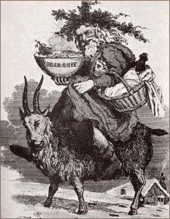
The Yule Father or the History of Father Christmas


It seems that most people think of Odin as a warrior god, taking the souls of slain warriors up to Valhalla to feast and battle until Ragnarok. And yes that is an important aspect of this deity. Many of his heiti (names/aspects) relate to battle. However, that is the aspect of Odin I actually have the least amount of personal experience with. It makes sense, given that I’ve never served in the military. I’ve never been in battle myself, so I have no idea what that would be like, and I don’t pretend to.
For the next couple of posts about Odin, I am going to describe the aspects of him that I do relate to. I’m going to start with the first heiti of Odin that I met, which actually happened long before the events that I described in my last post. That was the first time I encountered Odin as Odin, but Odin is a god who likes to disguise himself. There are many stories in the Eddas where he goes out in disguise, sometimes even as a woman. He uses whatever mask he needs to suit his purposes. And it wasn’t until the past year or two that I really started to realize Odin was around in my life long before I knew it was him. In modern times he wears a disguise that you see everywhere at this time of year, and this disguise has enabled him to continue to receive offerings from millions of people around the world, or at least millions of children once a year.

They know this aspect of Odin as “Santa Claus.”

Now, sometimes when I mention that Santa is Odin to people, they have trouble believing it. I once mentioned it to a friend of mine, and he said, “But Santa is jolly! Odin isn’t jolly at all!” Even some fellow Heathens have trouble with the idea, and insist that Santa is really Thor, and his reindeer are really Thor’s goats, and both Santa and Thor like the color red. Thor is also much more “jolly”. Also, in Scandinavian countries, goats are associated with Yule, and those may very well be Thor’s goats.

But if you look at older depictions of Father Christmas, they look much more Odinic. He used to wear all sorts of colors besides red. He used to ride a horse instead of a sleigh pulled by reindeer (though reindeer are still used as draft animals in certain parts of Scandinavia, so he could have reindeer too). When I was a child, I knew there was something more to Santa. I knew there was more to him than just someone who gives you toys; there was something deeper, more powerful, more ancient. The toys were nice, but there was something about leaving that offering of cookies out by the hearth on that magical night of Christmas Eve, knowing that during the night while I slept, this ancient, powerful being would come to collect his offering and leave me gifts in return. It gave me a warm, fuzzy feeling in my heart, but also made the hair on the back of my neck stand on end. That a being that was powerful enough to do what Santa did still cared about little kids enough to visit use every year and bring us gifts, that was just amazing. And he cares about all little kids, not just the rich ones. He’d even give gifts to the poor kids who really needed them, and I was sure he actually cared about them more. Nobody was considered an outsider, unwanted, or unloved when it comes to Santa.

I held onto my belief in Santa long after many of my peers had given it up, though the belief that there was literally an old man bringing the gifts started to fall apart in the face of the evidence, such as how Santa had the exact same handwriting as my mom, except for the occasional year he had the handwriting of my dad, and he always used the exact same wrapping paper that we had. Finally, one year when I was still playing along with the Santa thing, my mom flat out told me, “Your mommy is Santa. All those presents you ever got were from me.” Maybe she was sick of doing the Santa thing and wanted to end it once and for all, but I was almost kind of insulted. For one thing, by now it wasn’t like I was so dumb that I didn’t know she was the one leaving the gifts. For another thing, I didn’t believe her that she was Santa, and I thought it was rather arrogant of her to make such a claim.
Yes, I got the message that we wouldn’t be doing the Santa thing anymore, and that my mother felt my sister and I were too old for it now. I was depressed for a few years after that because that magic had been taken out of Christmas. The idea that Santa is silly kids’ stuff and when you “grow up” you stop believing in it just seemed so depressing. Santa seemed like so much more than just a source of toys. I didn’t even want toys anymore. Toys were only a small part of the whole Santa ritual, and that’s why I didn’t like my mom saying she was “really Santa”. There was more to Santa than that.
When I was in my early 20’s I got a job at Barnes and Noble. It turned out to be the one retail job I hated the least out of all the ones I had, and I ended up working for them off and on for several years as I worked my way through college. Every Christmas they had this thing similar to the Salvation Army Angel Tree, except it was just for books. You’d get a tag for a needy child, and it would say what books the child would like. You’d buy one for the child, attach the tag to it, and leave it under the tree. I started doing that every year with one boy and one girl. I loved doing it. I felt that warm feeling in my heart and that prickle up my spine. When I lived in an apartment complex that had a toy drive for needy children, I always bought some things for it. I’ve always loved the whole gift-giving tradition, and even bought gifts for all my college friends at Yule, even if they didn’t think to give me anything. I figured out how to “believe in Santa” as an adult. Now I was one of Santa’s helpers. Santa’s helpers aren’t just elves; they’re anyone who gives a gift with no strings attached, just to add a little bit more warmth and brightness to the world. Santa’s helpers are the ones who actually buy, wrap, and give the gifts, but they do it under the direction of Santa, in Santa’s name, as his priests and priestesses, doing his work in the world.

I’ve seen modern paganism described as an effort to “re-enchant the world”. Since I was raised an atheist, Santa was my first source of enchantment. Atheists sometimes compare God to Santa Claus, implying belief in God is just as silly as belief in Santa Claus, but is it really that silly to believe in generosity, hospitality, and kindness? When I became a Wiccan, I accepted Santa as an aspect of “The God”, and maybe that was one of the reasons why the Wiccan God was easier for me to relate to. When I became Heathen, for a long time I didn’t believe the Odin-Santa connection because of the reasons I mentioned before, that Santa was too “nice” to be Odin. I understood that they had a historical connection, which is discussed in Santa’s Wikipedia article and also this funny cartoon “Irrefutable Proof that Santa is Odin”, which makes Santa seem rather scary. (Interestingly enough, my little sister was always terrified of Santa. Hmm. Maybe she sensed it too.)

But last Yule the last bit of doubt left my mind. At least for me, it turns out Santa was Odin all along. This means that Odin has been involved in my life from the very beginning, the implications of which I’m still figuring out. I remember an article I read once about whether it’s OK to “lie” to your children about Santa, and what kind of psychological effects that might have. I wish I could remember where it was from. I think it was from Psychology Today or something like that, because it was surprisingly well-written. The part that stood out to me was where it talked about how modern Western society’s view of these things is backwards from how things are viewed in traditional tribal societies. In Western society it’s OK for children to have “fantasies” like Santa Claus, and then when you “grow up” you stop believing in that nonsense and take on a more materialistic worldview. In more animistic or shamanic cultures, it’s the exact opposite. As a child, you’re focused on learning how the physical world works, and as you become older you gain more and more knowledge of the spiritual world.

I think this makes a lot of sense, especially given the choice you have once you get old enough to realize that your parents are the ones who buy those toys, wrap them, and leave them under the tree. In modern society, once one realizes that Santa is not an actual physical human being bringing you these physical toys and eating the physical cookies you left out for him, well, then that means he’s not real, right?

That makes sense if you believe that only physical things are real. Instead, that could be the point when you learn what Santa really is, and that your childhood understanding of Santa was too simplistic, but age-appropriate until you old enough to have a more nuanced understanding.

I plan on having a child someday, and I’ve been thinking about how I’m going to handle the issue of religion, since I wasn’t brought up with religion myself. I’ve been wondering how I’d teach a child about the gods (which is especially difficult because I’m not totally sure what a god is myself), and I realized that my atheist mom actually unintentionally introduced me to the concept by participating in the Santa tradition.

If you are not a Heathen, I think the Santa tradition can still be a vehicle for introducing children to the gods of your tradition. He could be Saturn, if you follow a more Greco-Roman tradition and celebrate Saturnalia at this time of year. He could be the Holly King aspect of the Wiccan God. He’s already Saint Nicholas for the Catholics, and I’m fine with that. Lots of pagan gods became saints to help people continue to worship them after the coming of Christianity.

But if you still think that Odin isn’t nice enough to be Santa, John T. Mainer wrote a really good blog post about it a few days ago. That post actually came up while I was still working on this one, so I had to completely rewrite mine. Another instance of another writer beating me to something and explaining it better than I could! That post perfectly describes Jolnir, the Yule Father, the Odin I’ve known since I was a child. May he bring you peace, joy, inspiration, and wonder this holiday season.