the intangible rings of the upper spheres,
so that creation is, in truth,
the process of making tangible the intangible
by extending the intangible into various vibratory rates.”
― Manly P. Hall
The Qabbalah, the Secret Doctrine of Israel
― Manly P. Hall
The Qabbalah, the Secret Doctrine of Israel
About Me
Translate
Due to the changes and updates being done this section is going to change
Search the archive
Welcome Traveler to My Little Occultshop
Welcome Traveler,
It's been a whirlwind of a month, I can't say thank you enough for your support, starting next month I'll be putting out a monthly magazine about topics related to that month.
So what's new
I've added a new section that covers meals of the ancient world and a section about herbal remedies will be coming soon.
As always may your travels be light and your path be pleasant to you and your family, blessings.
Magus
Featured Sponsors
Here is what's new
Yeah I know its been 3 years since I've posted anything new. I burnt out from everything I was putting into this. and tbh what made me come back was the fact that even after 3 years this is still popular. I can't thank you enough for your continued support.
So what's new well I have a new address and with covid I've had a bit of free time. so maybe its time I got back into the captains chair and got to setting a course to places undiscovered. A part of me is happy while a part isn't because he know what's up and he doesn't like doing the hard long hours of labor.
Most popular post
My latest post on my Facebook Page My Little Occult Shop
Its been what 2 possibly 3 years since I last posted. Burn out is what happened. I got so overwhelmed with everything that it just got to ...
Wednesday, November 29, 2017
Lecture: Ripley's Alchemy Part 4 THE FOURTH GATE - CONJUNCTION
After the chapter of natural Separation,
By which the elements of our Stone be dissevered,
Here follows the chapter of secret Conjunction,
Which Natures repugnant joins to perfect unity.
And so them knitteth that none from the other may flee,
When they by fire shall be examined,
They be together so surely conjugated.
And therefore Philosophers give this definition,
Saying this Conjunction is nothing else,
But a copulation of dissevered qualities,
Or a co-equation of principles, as others tell,
But some men with Mercury that the Apothecary sells,
Meld bodies which cannot divide their matter,
And therefore they slip aside.
For until the time the soul be separated,
And cleansed from its original sin with the water,
And thoroughly spiritualised,
The true Conjunction you may never begin.
Therefore the soul first from the body twin,
Then of the corporeal part and of the spiritual.
The soul shall cause perpetual conjunction.
Of two conjunctions the philosophers do mention make,
Gross when the body with Mercury is reincrudate,
But let this pass, and to the second take heed,
Which is as I have said, after separation celebrated,
In which the parties be left with least to colligate,
And so promoted unto a most perfect temperance,
That never after amongst them may be repugnance.
Thus Separation causes true Conjunction to be had,
Of water and air, with earth and fire,
But that each element into other may be laid,
And so abide for ever to your desire,
Do as do daubers with clay or mire,
Temper them thick and make them not too thin,
So do updrying, you shall the rather win.
But manners there be of our Conjunction three,
The first is called Diptative by Philosophers,
Which between the agent and patient must be,
Male and female, Mercury and Sulphur vive,
Matter and form, thin and thick to thrive,
This lesson will help thee without any doubt,
And our Conjunction truly to bring about.
The second manner is called Triptative,
Which is Conjunction, made of things three,
Of body, soul and spirit, that they not strive,
Which trinity you must bring to unity,
For as the soul to the spirit must bonded be,
So the body must the soul to him knit,
Out of thy mind let not this lesson flit.
The third manner and also the last of all,
Four Elements together which join to abide,
Tetraptative certainly the Philosophers do call it,
And especially Guido de Montano whose fame goes wide,
And therefore in most laudable manner this tide,
In our Conjunction four elements must aggregate in due proportion,
Which first were separated asunder.
Therefore like as the woman has veins fifteen,
And the man has but five to the act of their fecundity,
Required in our Conjunction first I mean,
So must the man our Sun have of his water three,
And nine his wife, which three to him must be.
Then like with like will joy have for to dwell,
More of Conjunction I needeth not to tell.
This chapter I will conclude right soon,
Therefore gross Conjunction charging thee to make but one,
For seldom have strumpets children of them bore,
And so you shall never come by our stone,
Without you let the woman lie alone,
That after she has once conceived of the man,
Her matrix be shut up from all others then.
For such as add ever more crude to crude,
Opening their vessel letting their matters cool,
The sperm conceived they nourish not but delude themselves,
And spoil their work each time.
If you therefore wish to do well,
Close up your matrix and nourish the seed,
With continual and temperate heat if you will speed.
And when your vessel has stood by five months,
And clouds and eclipses be passed each one,
The light appearing, increase your heat, then believe,
Until bright and shining in whiteness be your Stone.
Then may you open your glass anon,
And feed your child which is born,
With milk and meat, aye more and more.
For now both moist and dry is so contemperated,
That of the water earth has received impression,
Which never after that asunder may be separate,
So water to earth has given ingression,
That both together to dwell have made profession,
And water of earth has purchased a retinue,
They four made one never more to strive.
Thus in two things all our intent does hang,
In dry and moist, which are two contraries.
In dry, that it bring the moist to fixing,
In moist, that it give liquefaction to the earth also,
That of them a temperament may thus go forth,
A temperament not so thick as the body is,
Neither so thin as water without miss.
Loosing and knitting thereof be two principles,
Of this hard science, and poles most principal,
How be it that other principles be many more,
As shining fanes which I shall show,
Proceed therefore unto another wall,
Of this strong Castle of our Wisdom,
That in at the fifth Gate you may come.
The end of the Fourth Gate.
Lecture: Ripley's Alchemy Part 3 THE THIRD GATE - SEPARATION
Separation does each part from the other divide,
The subtle from the gross, the thick from the thin,
But look you set aside manual Separation,
For that pertains to fools that little good do win,
But in our Separation Nature does not cease,
Making division of qualities elemental,
Into a fifth degree till they be turned all.
Earth is turned into water black and blue,
And water after into air under very white,
Then air into fire, elements there be no more,
Of these is made our stone of great delight,
But of this Separation much more must we write,
And Separation is called by Philosophers definition,
Tetraptative dispersion of the said four elements.
Of this Separation I find a like figure,
Spoken by the prophet in the psalmody,
God brought out of a stone a flood of water pure,
And out of the hardest rock oil abundantly,
So out of our precious stone if you be wise,
Oil incombustible and water you shall draw,
And thereabouts you need not at the coals to blow.
Do this with heat easy and nourishing,
First with moist fire and after that with dry,
Drawing out the phlegm with patience,
And after that the other Natures wisely,
Dry up thine earth till it be thirsty,
By Calcination, else you labour in vain,
And then make it drink up the moisture again.
Thus you must oftentimes make Separation,
Dividing your waters into two parts,
So that the subtle from the gross you take,
Till the earth remain below in colour blue,
That earth is fixed to abide all woe,
The other part is spiritual and flying,
But you must turn them all into one thing.
Then oil and water with water shall distil,
And through its help receive moving,
Keep well these two that you not spoil,
Your work for lack of due closing,
And make your stopple of glass,
Melting the top of your vessel together with it,
Then Philosopher-like it is shut up.
The water wherewith you may revive the stone,
Look you distil before you work with it,
Oftentimes by itself alone,
And by this sight you shall well know,
When it is quit from feculent faeces,
For some men can it with Saturn multiply,
And other substances which we defy.
Distil it therefore till it be clean,
And thin like water as it should be,
As heaven in colour bright and shine,
Keeping both figure and ponderosity,
Therewith did Hermes moisten his tree,
Within his glass he made it grow upright,
With flowers coloured beautiful to sight.
This water is like to the venomous Tyre,
Wherewith the mighty miracle is wrought,
For it is a poison most strong of ire,
A stronger poison cannot be thought,
At apothecaries therefore it is often sought,
But no man shall be intoxicated by it,
From the time it is elixerated into medicine.
For then it is the miracle true,
It is of poison most expulsive,
And in its workings does marvels show,
Preserving many from death to life,
But look you meddle it with no corrosive,
But choose it pure and quick running,
If thou thereby will have winning.
It is a marvellous thing in kind,
And without it nothing can be done,
Therefore did Hermes call it his wind,
For it flies up from Sun and Moon,
And makes our stone to fly with it soon,
Reviving the dead and giving life,
To Sun and Moon, husband and wife.
Which if they were not by craft made quick,
And their fatness with water drawn out,
So the thin was severed from the thick,
You should never bring this work about,
If you will speed therefore without doubt,
Raise up the birds out of their nest,
And after again bring them to rest.
Water with water will accord and ascend,
And spirit with spirit, for they be of one kind,
Which after they be exalted make to descend,
So shall you divide that which Nature formerly did bind,
Mercury essential turning into wind,
Without which natural and subtle Separation,
May never complete profitable generation.
Now to help you in at this gate,
The last secret I will tell to you,
Your water must be sublimated seven times,
Else no kindly Dissolution shall be,
And you shall not see putrefying,
Like liquid pitch, nor colours appearing,
For lack of fire working within your glass.
There are four fires which you must understand,
Natural, unnatural, against Nature also,
And elemental which does burn the brand.
These four fires we use and no more,
Fire against nature must do your bodily woe,
This is our Dragon as I you tell,
Fiercely burning as the fire of hell.
Fire of nature is the third menstrual,
That fire is natural in each thing,
But fire occasional, we call unnatural,
As heat of ashes, and baths for putrefying,
Without these fires you may nought bring to Putrefaction,
For to be separate,
Your matters together proportionate.
Therefore make fire within your glass,
Which burns the body more than fire Elemental,
If you will win our secrets,
According to your desire.
Then shall your seeds both rot and spire,
By help of fire occasional,
That kindly after they may be separated.
Of Separation the Gate must thus be won,
That furthermore yet you may proceed,
Towards the Gate of secret Conjunction,
Into the inner Castle which will you lead,
Do after my counsel if you will speed,
With two strong locks this Gate is shut,
As consequently you shall well know.
The end of the Third Gate.
Lecture: Ripley's Alchemy Part 2 THE SECOND GATE - SOLUTION
Now I will speak a word or two of Solution,
Which reveals what ere was hid from sight,
And makes thin, things that were thick,
By virtue of our first menstruum clear and bright,
In which our bodies have been eclipsed from light,
And of their hard and dry compaction subtilated,
Into their own first matter kindly retrogradated.
One in gender they be, and in number two,
Whose father is the Sun, the Moon the mother,
Mercury moves between,
These and no more be our Magnesia, our Adrop,
And no other things be here, but only sister and brother,
That is to mean, agent and patient,
Sulphur and Mercury, co-essential to our intent.
Betwixt these two, equally contrary,
Engendered is our mean most marvellous,
Which is our Mercury and unctuous menstrum,
Our secret Sulphur working invisibly,
More fiercely than fire burning the body,
Dissolving the body into mineral water,
Which we do call night or darkness in the North.
But yet I trust, you understand not utterly,
The very secret of the Philosopher's Dissolution.
Therefore understand me, I counsel you wisely,
For the truth I will tell you without delusion,
Our Solution is cause of our Congelation,
For Dissolution on the one side corporeal,
Causes Congelation on the other side spiritual.
And we dissolve into water which wets no hand,
For when the earth is integrally incinerated,
Then is the water congealed; this understand,
For the elements be so together concatenated,
That when the body is from his first form altered,
A new form is induced immediately,
For nothing is without form utterly.
And here a secret I will disclose to you,
Which is the ground unto our secrets all,
Which if you do not know you shall but lose,
Thy labour and costs both great and small.
Take heed therefore that in error you not fall,
The more your earth, and the less your water be,
The rather and better solution shall you see.
Behold how ice to water does relent,
And so it must, for water it was before,
Right so again to water our earth is gone,
And water thereby congealed for evermore.
For after all Philosophers that ever were born,
Each metal was once mineral water,
Therefore with water they turn to water all.
In which water of kind occassionate,
Of qualities been repugnant and diversity.
Things into things must therefore be rotated,
Until diversity be brought to perfect unity.
For Scripture records when the earth shall be troubled,
And into the deep sea shall be cast,
Mountains and bodies likewise at the last.
Our bodies be likened conveniently to mountains,
Which after high Planets we name,
Into the deepness therefore of Mercury,
Turn them, and keep you out of blame,
For then you shall see a noble game,
How all shall become powder as soft as silk,
So does our rennet kindly curd our milk.
Then have the bodies lost their first form,
And others been induced immediately,
Then you have well bestowed your cost,
Whereas others uncunningly must go by,
Not knowing the secrets of our Philosophy.
Yet one point more I must tell thee,
How each body has dimensions three.
Altitude, Latitude and also Profundity,
By which always we must turn our wheel,
Knowing that your entrance in the West shall be,
Your passage forth to the North if you do well,
And there your lights lose their light each deal,
For there you must abide by ninety nights,
In darkness of purgatory without lights.
Then take your course up to the East anon,
By colours variable, passing in manifold ways,
And then be winter and spring nigh overgone,
To the East therefore devise your ascending,
For there the Sun with daylight does uprise in summer,
And there disport you with delight,
For there your work shall become perfect white.
Forth from the East into the South ascend,
And sit you down there in the chair of fire,
For there is harvest, that is to say an end
Of all this work after your own desire,
There shines the Sun up in his Hemisphere,
And after the eclipse is in redness with glory,
To reign as King upon all metals and Mercury.
All in one glass must all this thing be done,
Like to an egg in shape and closed well,
Then you must know the measure of firing,
Which if unknown your work is lost each deal.
Never let your glass be hotter than you may feel,
And suffer still in your bare hand to hold,
For fear of losing, as Philosophers have told.
Yet to my doctrine futhermore attend,
Beware your glass you never open nor move,
From the beginning until you have made an end,
If you do otherwise, your work may never achieve,
Thus in this Chapter, which is but brief,
I have taught you your true Solution,
Now to the third gate go, for this is won.
The end of the second gate.
Lecture: Ripley's Alchemy Part 1 CALCINATION - THE FIRST GATE
Calcination is the purgation of our stone,
And restoration also of its natural heat.
Of radical humidity it looseth none,
Inducing solution into our stone most mete.
Seek after philosophy I you advise
But not after the common guise,
With sulphur and salts prepared in diverse ways.
Neither with corrosives, nor with fire alone,
Nor with vinegar, nor with ardent water,
Neither with the vapour of lead,
Our stone is calcined according to our intent.
All those who to calcining so be bent,
From this hard science withdraw their hand,
Till they our calcining better understand.
For by such calcining, their bodies will be spoiled,
For it diminishes the moisture of our stone.
Therefore when bodies to powder be burnt,
Dry as ashes of tree or bone,
Of such calxes then will we will have none,
For moisture we multiply radical,
In our calcining, diminishing none at all.
And for a sure ground of our true calcination,
Work wisely only kind with kind.
For kind to kind has appetite and inclination.
He who does not know this, in knowledge is blind,
And may wander forth as mist in the wind,
Knowing never with profit where to alight,
Because he conceives not our words aright.
Join kind to kind therefore as reason is,
For as every young shoot answers its own seed,
Man begets man, a beast a beast, likewise,
Further to treat of this there is no need.
But understand this point if you will succeed,
Each thing is first calcined in its own kind,
This well concealed fruit therein shall you find.
And we make calx unctuous both white and red,
Of three degrees or our base be perfect,
Fluxible as wax, else stand they in little stead.
By right long process as philosophers do write,
A year we take or more for our respite.
For in less space our calxes will not be made,
Able to tinge with colour that will not fade.
And for thy proportions you must beware,
For therein may you be beguiled.
Therefore so that your work will not be marred,
Let your body be subtly filled with Mercury,
As much then so subtiled,
One of the Sun, two of the Moon,
Till altogether like pap be done.
Then make the Mercury four to the Sun,
Two to the Moon as it should be,
And thus your work must be begun,
In figure of the Trinity,
Three of the body and of the spirit three,
And for the unity of the substance spiritual,
One more than of the substance corporeal.
By Raymond's repertory this is true Proportion,
There who choose to look.
The same my Doctor did show to me,
But three of the spirit Bacon took,
To one of the body,
For which I lay awake many a night before I knew it.
And both be true, take which you choose.
If the water also be equal in proportion to the earth,
With heat in due measure,
From them shall spring a new young shoot,
Both white and red in pure tincture,
Which in the fire shall ever endure.
Kill you the quick, the dead revive;
Make trinity unity without any strife.
This is the surest and best proportion,
For where is least of the part spiritual,
The better therefore shall be solution,
Than if you did it swell with water,
Your earth overglutting which loses all,
Take heed therefore to the potter's loam,
And make you never too wet your womb.
That loam behold how it is tempered,
The mean also how it is calcinated,
And ever look you bear this in mind,
That never your earth with water be suffocated.
Dry up your moisture with heat most temperate,
Help Dissolution with moisture of the Moon,
And Congelation with the Sun, then you have done.
Four natures into the fifth so shall you turn,
Which is a nature most perfect and temperate,
But hard it is with your bare foot to spurn,
Against a bar of iron, or steel newly sharpened,
For many do so which be infatuated,
When they such high things take in hand,
Which they in no way do understand.
In eggs, in vitriol, or in blood,
What riches they go there to find.
If they Philosophy understood,
They would not in working be so blind,
To seek Gold and Silver out of their kind.
For like as fire is of the burning principle,
So is the principle of gilding likewise.
If you intend therefore to make,
Gold and Silver by craft of our philosophy,
Take neither eggs nor blood,
But Gold and Silver which naturally Calcined,
Wisely and not manually,
A new generation will be brought forth,
Increasing their kind as does everything.
And if it were true that profit might be,
In things which are not metalline,
In which be colours pleasant to see,
As in blood, eggs, hair, urine or wine,
Or in mean minerals dug out of the mine,
Yet must that element be putrefied and separated,
And with elements of perfect bodies be disposed.
But first make rotation of these elements,
And into water your earth turn first of all,
Then of your water make air by levitation,
And air make fire, then I will call you a Master,
Of all our secrets great and small.
The wheel of Elements then you can turn about,
Truly understanding our writings without doubt.
This done, go backwards, turning the wheel again,
And presently turn your fire into water,
Air into earth, else you will labour in vain.
For so to temperament is brought our stone,
And Nature's contractions, four are made one,
After they have three times been circulated,
And also your base is perfectly consummated.
This under the moisture of the Moon,
And under the temperate heat of the Sun,
Your Elements shall be incinerated soon,
And then you have the mastery won.
Thank God your work was then so begun,
For there you have one true token,
Which first in blackness will be shown to you.
That token we call the Head of the Crow,
And some men call it the Crow's bill,
Some call it the ashes of Hermes tree,
And thus they name it after their will,
Our Toad which eats his fill of the earth,
Some name it by that which it is mortified,
The spirit with venom intoxicated.
But it has an infinity of names, I say,
For it is named after each thing that is seen to be black,
Till the time it waxes white,
Then it has names of more delight,
Called after all things that be full white,
And the red likewise after the same,
Of all red things does take the name,
You are now within the first gate,
Of the Castle where the Philosophers dwell.
Proceed wisely that you may win,
And go though more gates of that Castle.
This Castle is round as any bell,
And gates it has yet eleven more,
One is conquered, now to the second go.
The end of the First Gate.
Tuesday, November 28, 2017
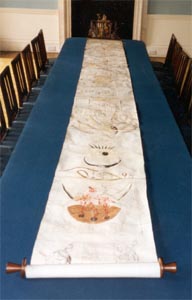
Ripley's alchemical scrolls

The alchemical scrolls which are associated with George Ripley are unusual manuscripts which illustrate the pursuit of the Philosophers' Stone.
Ripley was a canon of Bridlington in Yorkshire who lived from about 1415 to 1495. He was renowned as an alchemist and author of alchemical works in rhyme, and his verses are used on most of the scrolls. Alchemical scrolls are rare and there are only 16 in the UK; in London there are seven in the British Library, and two in the Wellcome Library; the Bodleian Library in Oxford has five, and the Fitzwilliam Museum in Cambridge has one, the longest at 21 feet. There are also four scrolls in the United States of America ( Yale University; Princeton University; Huntington Library, San Marino;and the Getty Center for the History of Art and the Humanities, Santa Monica) all of which were bought at sales in London.
The provenance of Ripley scrolls is obscure in many cases but they usually belonged to aristocratic and wealthy individuals. When and where they were produced is uncertain although it is thought that some of them originated in Lübeck in the 16th century. The Edinburgh scroll is traceable back to the 1640s at the latest. Where it came from before this is intriguing. Its owner Sir George Erskine of Innertiel (now Inverteil) near Kirkcaldy who was born in about 1570 and died in 1646), had contacts with other aristocrats in Scotland and London who studied alchemical manuscripts. He was also in touch with Rosicrucians in Hesse, Germany, but it is unlikely that they brought the scroll to Erskine.
The Ripley Scroll
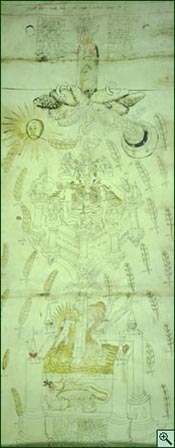
The scroll forms an appropriate and relevant part of the alchemical manuscripts which had belonged to Erskine and were presented by his grandson the Earl of Cromartie to the College in 1707. George Mackenzie (1630-1714), first Earl of Cromartie, had been involved in 1685 as Viscount Tarbat in an official capacity in the ratification of the 1681 charter of the College. He was on very friendly terms with founding members of the College including Balfour, Sibbald, Pitcairne and Stevenson, all like him with a Fife background. While it is likely that Cromartie was made a Fellow of the College his name is not amongst those Fellows or honorary Fellows of the period who are listed from 1681 in the Charter and Regulations (1789). However the records almost immediately after the College was established, for the period December 1682 to 1694 are missing and it is likely that he was made a Fellow during that time. The scroll was shown to the Scottish Society of Antiquaries in 1827 by Dr William Moncrieff the College Librarian, and the first account of it, published in 1876, is based on Moncrieff's detailed description. The scroll contains a series of pictures which purport to illustrate the steps necessary for the acquisition of the Philosophers' Stone with text in Latin phrases, and alchemical poems by George Ripley. The sequence of emblems is a version of the pattern most often found in these scrolls and consists of a series of figures which are well and skilfully drawn.

The scroll is about 18 feet 4 inches(5.5m) long and about 23 inches (57.5cms) wide. It consists of seven large sheets of vellum each about 32 inches(80cms) long except for the last section which is 9 inches(22.5cms) long. They are attached to a linen backing and there is a roller at the top and a wooden bar at the bottom. The top shows evidence of wear, and perhaps damp at some time, so that the images are rather faint. It was copied for Moncrieff and Small's paper by a photolithographic process, much used from the early 1860s on, which gives a very clear illustration of the drawings. The text is impossible to read from this but all of it is in Moncrieff's account. Hand written at the top is: Edinburgh 19t Die Junii 1707. Hoc mysticum symbole, in avita Bibliotheca Doni Georgii Areskine, Equitis aurati, supremi senatus et colidgii Justicii in Scotia Senator inter primos Justitia et eruditione clarus philosophij Hermeticae et aluminus et decor, Regumque sui aevi a conciliis secretis almo et spectabile Collegio Medicorum Edinbur Regali DD. Geo Cromartio.

Although the series of images is a continuum and each leads into the next it can be divided arbitrarily for descriptive purposes into sections.
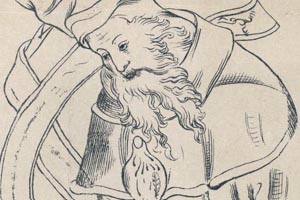
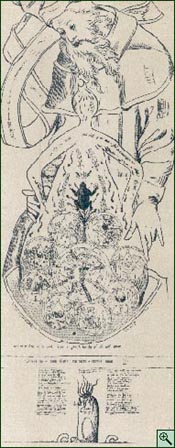
The Ripley Scroll begins with a large bearded figure clutching an egg-shaped vase. The figure, in cap/headdress and robe, is almost certainly that of Hermes Trismegistus (thrice-greatest) the legendary founder of alchemy who is identified with the Egyptian god of healing Thoth.
The appearance is consistent with other portraits of him over the time at which the scrolls were originally produced: for example, Stefano's mosaic on the floor of Siena Cathedral (1488). The vessel which he holds is an Hermetic Vase (Vase of the Philosophers; Philosopher's Egg). The egg shape was highly significant and was symbolic of creation and in it the Great Work of making the Philosopher's Stone was carried out. Needless to say the vessel is hermetically sealed by a stopper.

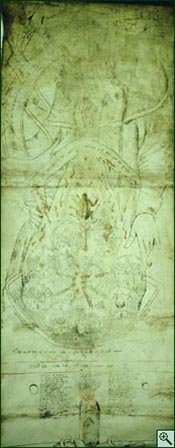
The vase contains a series of eight roundels linked by chains to a larger central roundel. Each small roundel has an hermetic vase containing one or two homunculi, male or female, flanked by monk-like figures. The larger central roundel has two seated figures holding a book; one of the figures appears to be Hermes again. In the top of the vase is a toad, and below it there are the words 'The black sea, the black lune, the black soll'; below this between two sets of verses is a furnace.
The furnace is set on leaves at the top of a tree below which a curious female figure with a dragon's tail and webbed feet but a human trunk (a Melusine) and with her head set between sun and moon, hangs downwards clutching a male child.

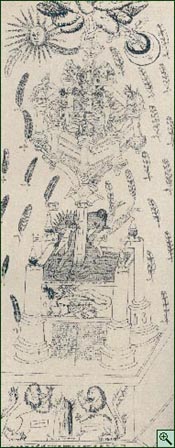
Below is a vine with grapes emerging from a seven sided pool or cistern bounded by seven pillars on each of which stands a monkish figure clutching an hermetic vase. In the pool stand naked male and female figures. The whole rests on an angular pillar which itself is set in a second four sided pool. Embracing the pillar is a large male figure like Samson, with one foot in the water having on his left a winged angel, and on his right another human figure with an indeterminate spiky structure behind it.
The front of the pool is decorated with a winged dragon spewing a toad from its mouth. A number of lines of verse come below this. These are in Ashmole's Theatrum Chemicum Britannicum, 1652 where they are attributed to Ripley. At each of the four corners of the structure is a pillar with an hermetic vase.

Each side of this section of the scroll is decorated with feathers. The pool rests on a base at the front of which are a red lion (left), and a green lion (right), on either side of a furnace with the words 'The mounthe of Cholerick beware'.
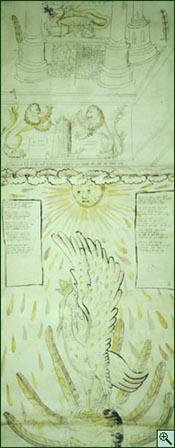
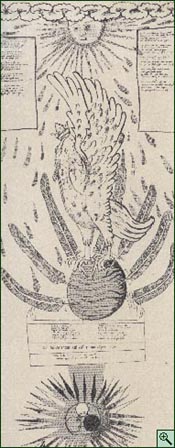
A large sun with eyes and mouth follows, then the striking figure of the crowned Bird of Hermes biting its left wing and standing on an orb into which seven feathers are stuck.
More feather-like objects are apparently falling from the sun's rays. Some more verses are set below the orb, after which there is another orb of a different kind containing linked white black and green balls within it, and with rays emanating from it.
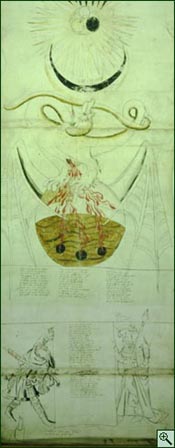
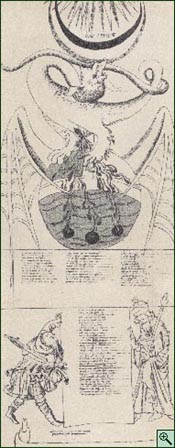
This orb is set in a lunar structure below which is a dragon whose wings do not seem to be attached to its body but to the orb on which it stands. The dragon is bleeding from its belly, the drops flowing into the orb which has three black balls in it. Three paragraphs of poetry follow.

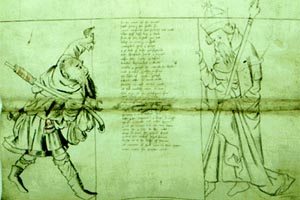
Finally two figures grasp either side of a column of poetry. The figure on the left is either a pilgrim or perhaps a philosopher (Ripley himself ?) carrying a curious staff which at its lower end is a shod hoof and has its upper end clothed in a scroll.
On the right is a figure in ecclesiastical robes with a crown and long staff, possibly Hermes again. Interspersed throughout the scroll are phrases in English and Latin, some of the latter in abbreviated form.
While the scrolls embody many conventional alchemical symbols the interpretation of these is obscure and a matter for conjecture. Amongst others the psychiatrist Jung has offered explanations of some of the imagery. As in much alchemical writing and imagery there is an evident Christian symbolism throughout. Some of the symbols are familiar alchemical ones: hermetic vases, a toad, the dragon, the Bird of Hermes and the red and green lions. But what they represent is another matter and can differ from one use to another. The toad often signifies earthly matter, or sophic sulphur in which the grosser physical properties of sulphur are absent. The Bird of Hermes which is shown as eating its wing has been interpreted as a stabilising act in relation to mercury. However, mercury does not always represent the familiar quicksilver but is rather a clue to properties more spiritual than chemical. The red lion may represent sulphur; the green lion mercury, or vitriol, or perhaps antimony. The bleeding dragon is probably a symbolic pelican 'vulning' itself, which is a common motif often with religious significance. There is so much detail in the scrolls' imagery that there is still a long way to go in explaining what lies behind it.
Monday, November 27, 2017
Lecture: The Rose Cross
The Rose Cross is associated with a number of different schools of thought, including that of the Golden Dawn, Thelema, the OTO, and the Rosicrucians (also known as the Order of the Rose Cross). Each group offers somewhat different interpretations of the symbol. This should not be surprising as magical, occult and esoteric symbols are frequently used to communicate ideas more complex than is possible to express in speech.
The Cross
Cross-shaped objects are commonly used in occultism too represent the four physical elements. Here each arm is colored to represent one element: yellow, blue, black and red to represent air, water, earth and fire.
These colors are also repeated on the bottom portion of the cross. The white on the upper portion of bottom arm represents spirit, the fifth element.
The cross can also represent dualism, two forces going in conflicting directions yet uniting at a central point. The union of rose and cross is also a generative symbol, the union of male of female.
Finally, the cross’s proportions are made up of six squares: one for each arm, an extra one for the lower arm, and the center. A cross of six squares can be folded into a cube.
THE ROSE
The rose has three tiers of petals. The first tier, of three petals, represents the three basic alchemical elements: salt, mercury and sulfur. The tier of seven petals represents the seven Classical planets (The Sun and Moon are considered planets here, with the term “planets” indicating the seven bodies that appear to circle the earth independently of the star field, which moves as a single unit). The tier of twelve represent the astrological zodiac. Each of the twenty-two petals bears one of the twenty-two letters in the Hebrew alphabet and also represents the twenty-two paths on the Tree of Life.
The rose itself has a myriad assortment of additional meanings associated with it:
It is at once a symbol of purity and a symbol of passion, heavenly perfection and earthly passion; virginity and fertility; death and life. The rose is the flower of the goddess Venus but also the blood of Adonis and of Christ. It is a symbol of transmutation - that of taking food from the earth and transmuting it into the beautiful fragrant rose. The rose garden is a symbol of Paradise. It is the place of the mystic marriage. In ancient Rome, roses were grown in the funerary gardens to symbolize resurrection. The thorns have represented suffering and sacrifice as well as the sins of the Fall from Paradise. ("A Brief Study of The Rose Cross Symbol," no longer online)
Inside the large rose is a smaller cross bearing a another rose. This second rose is depicted with five petals. Five is the number of the physical senses: sight, hearing, touch, taste, and smell, and it is also the number of man’s extremities: two arms, two legs, and the head. Thus, the rose represents humanity and physical existence.
THE THREE SYMBOLS AT THE END OF EACH ARM
The three symbols repeated at the end of all four arms stand for salt, mercury and sulfur, which are the three basic alchemical elements from which all other substances derive.
The three symbols are repeated on each of the four arms of the cross, numbering a total of twelve. Twelve is the number of the zodiac, comprised of twelve symbols that circle the heavens throughout the year.
THE HEXAGRAM
Hexagrams commonly represent the union of opposites. It is composed of two identical triangles, one pointing up and one pointing down. The point-up triangle can represent ascending toward the spiritual, while the point-down triangle can stand for the divine spirit descending to the physical realm.
THE SYMBOLS AROUND AND IN THE HEXAGRAM
The symbols in and around the hexagram represent the seven Classical planets. The symbol for the Sun is in the center. The sun is generally the most important planet in Western occultism. Without the Sun, our planet would be lifeless. It is also commonly connected with the light of divine wisdom and the purification properties of fire, and was sometimes considered the visual manifestation of God’s will in the universe.
On the outside of the hexagrams are the symbols for Saturn, Jupiter, Venus, the Moon, Mercury, and Mars (clockwise from top). Western occult thought generally considers the planets in the farthest orbits from the Earth in an earth-centric model) to be the most spiritual, because they are the furthest from the physicality of the Earth.
Thus, the top three planets are Saturn, Jupiter and Mars, while the bottom three are Mercury, Venus and the Moon.
The cross-shaped sign, represented in its simplest form by a crossing of two lines at right angles, greatly predates the introduction of Christianity, in both East and West. It goes back to a very remote period of human civilization. It is supposed to have been used not just for its ornamental value, but also with religious significance. It may have represented the apparatus used in kindling fire, and thus as the symbol of sacred fire or as a symbol of the sun, denoting its daily rotation. It has also been interpreted as the mystic representation of lightning or of the god of the tempest, or the emblem of the Aryan pantheon and the primitive Aryan civilization.
Ankh
Another associated symbol is the ansated cross (ankh or crux ansata) used in ancient Egypt. It was often depicted in the hands of the goddess Sekhmet, and as a hieroglyphic sign of life or of the living. Egyptian Christians (Copts) adopted it as the emblem of the cross.In his book,
The Worship of the Dead, Colonel J. Garnier wrote: "The cross in the form of the 'Crux Ansata' ... was carried in the hands of the Egyptian priests and Pontiff kings as the symbol of their authority as priests of the Sun god and was called 'the Sign of Life'."
Ndj & nfr
In the Bronze Age a representation of the cross as conceived in Christian art appeared, and the form was popularized. The more precise characterization coincided with a corresponding general change in customs and beliefs. The cross then came into use in various forms on many objects: fibulas, cinctures, earthenware fragments, and on the bottom of drinking vessels.
De Mortillet believed that such use of the sign was not merely ornamental, but rather a symbol of consecration, especially in the case of objects pertaining to burial. In the proto-Etruscan cemetery of Golasecca every tomb has a vase with a cross engraved on it. True crosses of more or less artistic design have been found in Tiryns, at Mycenæ, in Crete, and on a fibula from Vulci.
According to W. E. Vine, the cross was used by worshipers of Tammuz, an Ancient Near East deity of Babylonian origin who had the cross-shaped taw (tau) as his symbol.
Lectures: Eleusinian Mysteries
The Eleusinian Mysteries (Greek: Ἐλευσίνια Μυστήρια) were initiations held every year for the cult of Demeter and Persephone based at Eleusis in ancient Greece. They are the “most famous of the secret religious rites of ancient Greece.” Their basis was an old agrarian cult, and there is some evidence that they were derived from the religious practices of the Mycenean period. The mysteries represented the myth of the abduction of Persephone from her mother Demeter by the king of the underworld Hades, in a cycle with three phases, the descent (loss), the search, and the ascent, with the main theme being the ascent ( άνοδος : anodos) of Persephone and the reunion with her mother. It was a major festival during the Hellenic era, and later spread to Rome. Similar religious rites appear in the agricultural societies of Near East and in Minoan Crete.
The rites, ceremonies, and beliefs were kept secret and consistently preserved from antiquity. For the initiated, the rebirth of Persephone symbolized the eternity of life which flows from generation to generation, and they believed that they would have a reward in the afterlife. There are many paintings and pieces of pottery that depict various aspects of the Mysteries. Since the Mysteries involved visions and conjuring of an afterlife, some scholars believe that the power and longevity of the Eleusinian Mysteries came from psychedelic drugs. The name of the town, Eleusís, seems to be Pre-Greek and it is probably a counterpart with Elysium and the goddess Eileithyia.
Etymology
Eleusinian Mysteries (Greek: Ἐλευσίνια Μυστήρια) was the name of the mysteries of the city Eleusis. The name of the city Eleusis is Pre-Greek, and may be related with the name of the goddess Eileithyia. Her name Ἐλυσία ( Elysia) in Laconia and Messene, probably relates her with the month Eleusinios and Eleusis, but this is debated. The ancient Greek word "mystery" (μυστήριον) means "mystery or secret rite" and is related with the verb mueō (μυέω), which means initiation into the mysteries, and the noun mustēs(μύστης), which means one initiated. The word mustikós (μυστικός) means "connected with the mysteries", or "private, secret" (as in Modern Greek).
Demeter and Persephone
Triptolemus receiving wheat sheaves from Demeter and blessings from Persephone, 5th-century BC relief, National Archaeological Museum of Athens
The Mysteries are related to a myth concerning Demeter, the goddess of agriculture and fertility as recounted in one of the Homeric Hymns(c. 650 BC). According to the hymn, Demeter's daughter Persephone (also referred to as Kore, "maiden") was assigned the task of painting all the flowers of the earth, when she was seized by Hades, the god of death and the underworld. He took her to his underworld kingdom. Distraught, Demeter searched high and low for her daughter. Because of her distress, and in an effort to coerce Zeus to allow the return of her daughter, she caused a terrible drought in which the people suffered and starved. This would have deprived the gods of sacrifice and worship. As a result, Zeus relented and allowed Persephone to return to her mother.
According to the myth, during her search Demeter traveled long distances and had many minor adventures along the way. In one she taught the secrets of agriculture to Triptolemus. Finally, by consulting Zeus, Demeter reunites with her daughter and the earth returns to its former verdure and prosperity: the first spring.
Zeus, pressed by the cries of the hungry people and by the other deities who also heard their anguish, forced Hades to return Persephone. However, it was a rule of the Fates that whoever consumed food or drink in the Underworld was doomed to spend eternity there. Before Persephone was released to Hermes, who had been sent to retrieve her, Hades tricked her into eating pomegranate seeds, (either six or four according to the telling) which forced her to return to the underworld for some months each year. She was obliged to remain with Hades for six or four months (one month per seed) and lived above ground with her mother for the rest of the year. This left a long period of time when Demeter was unhappy due to Persephone's absence, neglecting to cultivate the earth. When Persephone returned to the surface, Demeter became joyful and cared for the earth again.
If one supposes that Persephone stayed with Hades for four months and Demeter eight months, corresponding to eight months of growth and abundance to be followed by four months of no productivity, the parallel with the Mediterranean climate of ancient Greece can be seen. The four months during which Persephone is with Hades correspond to the dry Greek summer, a period during which plants are threatened with drought. At the beginning of autumn when the seeds are planted, Persephone returns from the underworld and is reunited with her mother, and the cycle of growth begins anew.
This reading of the ritual, however, does not square with the central foundation document of the mystery, the Homeric Hymn to Demeter line 415, where Persephone is explicitly said to return in the spring of the year, not the fall: "This was the day [of Persephone's return], at the very beginning of bountiful springtime."
Her rebirth is symbolic of the rebirth of all plant life and the symbol of eternity of life that flows from the generations that spring from each other.
Mysteries
The Eleusinian Mysteries are believed to be of considerable antiquity. Some findings in the temple Eleusinion in Attica suggest that their basis was an old agrarian cult. Some practices of the mysteries seem to have been influenced by the religious practices of the Mycenaean period and thus predating the Greek Dark Ages. Excavations showed that, a private building existed under the Telesterion in the Mycenean period, and it seems that originally the cult of Demeter was private. In the Homeric Hymn is mentioned the palace of the king Keleos. One line of thought by modern scholars has been that the Mysteries were intended "to elevate man above the human sphere into the divine and to assure his redemption by making him a god and so conferring immortality upon him." Comparative study shows parallels between these Greek rituals and similar systems—some of them older—in the Near East. Such cults include the mysteries of Isis and Osiris in Egypt, the Adoniac of Syrian cults, the Persian mysteries, and the Phrygian Cabeirian mysteries.
Some scholars argued that the Eleusinian cult was a continuation of a Minoan cult, and that Demeter was a poppy goddess who brought the poppy from Crete to Eleusis. Some useful information from the Mycenean period can be taken from the study of the cult of Despoina, (the precursor goddess of Persephone), and the cult of Eileithyia who was the goddess of childbirth. The megaron of Despoina at Lycosura is quite similar with the Telesterion of Eleusis, and Demeter is united with the god Poseidon, baring a daughter, the unnamable Despoina (the mistress). In the cave of Amnisos at Crete, the goddess Eileithyia is related with the annual birth of the divine child, and she is connected with Enesidaon ( The Earth Shaker), who is the chthonic aspect of Poseidon.
At Eleusis inscriptions refer to "the Goddesses" accompanied by the agricultural god Triptolemos (probably son of Ge and Oceanus), and "the God and the Goddess" (Persephone and Plouton) accompanied by Eubuleus who probably led the way back from the underworld. The myth was represented in a cycle with three phases: the "descent", the "search", and the "ascent" ( Greek "anodos") with contrasted emotions from sorrow to joy which roused the mystae to exultation. The main theme was the ascent of Persephone and the reunion with her mother Demeter. At the beginning of the feast, the priests filled two special vessels and poured them out, the one towards the west, and the other towards the east. The people looking both to the sky and the earth shouted in a magical rhyme "rain and conceive". In a ritual, a child was initiated from the hearth (the divine fire). The name pais ( child ) appears in the Mycenean inscriptions, It was the ritual of the "divine child" who originally was Ploutos. In the Homeric hymn the ritual is connected with the myth of the agricultural god Triptolemos. The goddess of nature survived in the mysteries where the following words were uttered :" Mighty Potnia bore a great son". Potnia ( Linear B po-ti-ni-ja : lady or mistress), is a Mycenean title applied to goddesses and probably the translation of a similar title of Pre-Greek origin. The high point of the celebration was "an ear of grain cut in silence", which represented the force of the new life. The idea of immortality didn't exist in the mysteries at the beginning, but the initiated believed that they would have a better fate in the underworld. Death remained a reality, but at the same time a new beginning like the plant which grows from the buried seed. A depiction from the old palace of Phaistos is very close to the image of the "anodos" of Persephone. An armless and legless deity, grows out of the ground, and her head turns to a large flower.
According to Mylonas, the lesser mysteries were held "as a rule once a year in the early spring in the month of flowers, the Anthesterion," while "the Greater Mysteries were held once a year and every fourth year they were celebrated with special splendor in what was known as the penteteris. Kerenyi concurs with this assessment: "The Lesser Mysteries were held at Agrai in the month of Anthesterion, our February... The initiates were not even admitted to the epopteia [Greater Mysteries] in the same year, but only in September of the following year."
This cycle continued for about two millennia. In the Homeric Hymn to Demeter, King Celeus is said to have been one of the first people to learn the secret rites and mysteries of her cult. He was also one of her original priests, along with Diocles, Eumolpos, Polyxeinus and Triptolemus, Celeus' son, who had supposedly learned agriculture from Demeter.
Under Peisistratos of Athens, the Eleusinian Mysteries became pan-Hellenic, and pilgrims flocked from Greece and beyond to participate. Around 300 BC, the state took over control of the Mysteries; they were controlled by two families, the Eumolpidae and the Kerykes. This led to a vast increase in the number of initiates. The only requirements for membership were freedom from "blood guilt", meaning never having committed murder, and not being a "barbarian" (being unable to speak Greek). Men, women and even slaves were allowed initiation.
Participants
To participate in these mysteries one had to swear a vow of secrecy.
Four categories of people participated in the Eleusinian Mysteries:
- Priests, priestesses, and hierophants.
- Initiates, undergoing the ceremony for the first time.
- Others who had already participated at least once. They were eligible for the fourth category.
- Those who had attained épopteia (Greek: ἐποπτεία) (English: "contemplation"), who had learned the secrets of the greatest mysteries of Demeter.
Secrets
The outline below is only a capsule summary; much of the concrete information about the Eleusinian Mysteries was never written down. For example, only initiates knew what the kiste, a sacred chest, and the kalathos, a lidded basket, contained.
Hippolytus of Rome, one of the Church Fathers writing in the early 3rd century CE, discloses in Refutation of All Heresies that "the Athenians, while initiating people into the Eleusinian rites, likewise display to those who are being admitted to the highest grade at these mysteries, the mighty, and marvellous, and most perfect secret suitable for one initiated into the highest mystic truths: an ear of grain in silence reaped."
Lesser Mysteries
There were two Eleusinian Mysteries, the Greater and the Lesser. According to Thomas Taylor, "the dramatic shows of the Lesser Mysteries occultly signified the miseries of the soul while in subjection to the body, so those of the Greater obscurely intimated, by mystic and splendid visions, the felicity of the soul both here and hereafter, when purified from the defilements of a material nature and constantly elevated to the realities of intellectual [spiritual] vision." According to Plato, "the ultimate design of the Mysteries … was to lead us back to the principles from which we descended, … a perfect enjoyment of intellectual [spiritual] good."
The Lesser Mysteries took place in the month of Anthesteria under the direction of Athens' archon basileus. In order to qualify for initiation, participants would sacrifice a piglet to Demeter and Persephone, and then ritually purify themselves in the river Illisos. Upon completion of the Lesser Mysteries, participants were deemed mystai ("initiates") worthy of witnessing the Greater Mysteries.
Greater Mysteries
The Greater Mysteries took place in Boedromion – the third month of the Attic calendar, falling in late summer – and lasted ten days.
The first act (on the 14th of Boedromion) was the bringing of the sacred objects from Eleusis to the Eleusinion, a temple at the base of the Acropolis of Athens.
On the 15th of Boedromion, called Agyrmos "the Gathering", the hierophants (priests, or "those who show the sacred ones") declared prorrhesis, the start of the rites, and carried out the "Hither the victims" sacrifice (hiereía deúro). The "Seawards initiates" (halade mystai) began in Athens on 16th Boedromion with the celebrants washing themselves in the sea at Phaleron.
On the 17th, the participants began the Epidauria, a festival for Asklepios named after his main sanctuary at Epidauros. This "festival within a festival" celebrated the hero's arrival at Athens with his daughter Hygieia, and consisted of a procession leading to the Eleusinion, during which the mystai apparently stayed at home, a great sacrifice, and an all-night feast (pannykhís).
The procession to Eleusis began at Kerameikos (the Athenian cemetery) on the 19th, and from there the people walked to Eleusis, along what was called the "Sacred Way" (Ἱερὰ Ὁδός, Hierá Hodós), swinging branches called bacchoi. At a certain spot along the way, they shouted obscenities in commemoration of Iambe (or Baubo), an old woman who, by cracking dirty jokes, had made Demeter smile as she mourned the loss of her daughter. The procession also shouted "Íakch', O Íakche!", possibly an epithet for Dionysus, or a separate deity Iacchus, son of Persephone or Demeter.
Upon reaching Eleusis, there was an all-night vigil (pannychis) according to Mylonas and Kerenyi. perhaps commemorating Demeter's search for Persephone. At some point, initiates had a special drink of barley and pennyroyal, called kykeon, which has led to speculation about its chemicals perhaps having psychotropic effects.
Then, on the 20th and 21st of Boedromion, the initiates entered a great hall called Telesterion; in the center stood the Anaktoron ("palace"), which only the hierophants could enter, where sacred objects were stored. Before mystai could enter the Telesterion, they would recite, "I have fasted, I have drunk the kykeon, I have taken from the kiste ("box") and after working it have put it back in the kalathos ("open basket"). It is widely supposed that the rites inside the Telesterion comprised three elements: dromena ("things done"), a dramatic reenactment of the Demeter/Persephone myth; deiknumena ("things shown"), displayed sacred objects, in which the hierophant played an essential role; and finally legomena("things said"), commentaries that accompanied the deiknumena. Combined these three elements were known as the aporrheta ("unrepeatables"); the penalty for divulging them was death. Athenagoras of Athens, Cicero, and other ancient writers cite that it was for this crime (among others) that Diagoras was condemned to death in Athens; the tragic playwright Aeschylus was allegedly tried for revealing secrets of the Mysteries in some of his plays, but was acquitted. The ban on divulging the core ritual of the Mysteries was thus absolute, which is probably why we know almost nothing about what transpired there.
As to the climax of the Mysteries, there are two modern theories. Some hold that the priests were the ones to reveal the visions of the holy night, consisting of a fire that represented the possibility of life after death, and various sacred objects. Others hold this explanation to be insufficient to account for the power and longevity of the Mysteries, and that the experiences must have been internal and mediated by a powerful psychoactive ingredient contained in the kykeon drink. (See "entheogenic theories" below.)
Following this section of the Mysteries was the Pannychis, an all-night feast accompanied by dancing and merriment. The dances took place in the Rharian Field, rumored to be the first spot where grain grew. A bull sacrifice also took place late that night or early the next morning. That day (22nd Boedromion), the initiates honored the dead by pouring libations from special vessels.
On the 23rd of Boedromion, the Mysteries ended and everyone returned home.
For among the many excellent and indeed divine institutions which your Athens has brought forth and contributed to human life, none, in my opinion, is better than those mysteries. For by their means we have been brought out of our barbarous and savage mode of life and educated and refined to a state of civilization; and as the rites are called "initiations," so in very truth we have learned from them the beginnings of life, and have gained the power not only to live happily, but also to die with a better hope.Cicero, Laws II, xiv, 36
Demise
In 170 AD, the Temple of Demeter was sacked by the Sarmatians but was rebuilt by Marcus Aurelius. Aurelius was then allowed to become the only lay person ever to enter the anaktoron. As Christianity gained in popularity in the 4th and 5th centuries, Eleusis's prestige began to fade. The last pagan emperor of Rome, Julian, reigned from 361 to 363 after about fifty years of Christian rule. Julian attempted to restore the Eleusinian Mysteries and was the last emperor to be initiated into them.
The Roman emperor Theodosius I closed the sanctuaries by decree about 30 years later, in 392 AD. The last remnants of the Mysteries were wiped out in 396 AD, when ArianChristians under Alaric, King of the Goths, destroyed and desecrated the old sacred sites. The closing of the Eleusinian Mysteries in the 4th century is reported by Eunapius, a historian and biographer of the Greek philosophers. Eunapius had been initiated by the last legitimate Hierophant, who had been commissioned by the emperor Julian to restore the Mysteries, which had by then fallen into decay. According to Eunapius, the very last Hierophant was a usurper, "the man from Thespiae who held the rank of Father in the mysteries of Mithras."
According to historian Hans Kloft, despite the destruction of the Eleusinian Mysteries, elements of the cult survived in the Greek countryside. There, Demeter's rites and religious duties were partially transferred by peasants and shepherds onto Saint Demetrius of Thessaloniki, who gradually became the local patron of agriculture and "heir" to the pagan mother goddess.
Subscribe to:
Posts (Atom)